Key Takeaways
- Computer Recycling and Its Relation to ITAD: Computer recycling is a key part of ITAD, covering secure data destruction, refurbishment, resale, and responsible material recovery.
- ITAD Process: The six stages include intake, sorting, data destruction, parts harvesting, materials recycling, and reporting.
- Computer Recycling Importance: Responsible computer recycling reduces e-waste, protects communities from hazardous disposal, and recovers valuable resources.
ITAD is a process for how businesses manage surplus computers securely and responsibly. It includes asset collection, data destruction, refurbishment, resale, component recovery, and recycling. Computer recycling is one part of this broader process.
While 6.7 million tons of electronic waste is generated annually, only 16% is sent for recycling. This highlights the importance of responsible recycling.
Businesses can recover value through ITAD. For example, in one US regional bank project, an ITAD service provider reconciled 2,341 assets and destroyed 9,421 drives onsite, and generated $1.18 million in client recovery against $217,939 in project costs.
This represents how ITAD’s role goes beyond recycling. It protects data, extends computer lifespans, recovers value, and ensures responsible disposal.
What Is Computer Recycling and How Is It Related to ITAD?
Business computer recycling is the controlled recovery, reuse, and processing of old computers so their parts, materials, and data are handled safely. It prevents useful components from being wasted and keeps hazardous elements out of the environment. For businesses, it is often a part of the ITAD process that manages equipment from collection to data destruction, refurbishment, resale, and responsible recycling.
How ITAD Processing Works for Business
ITAD turns a complex operation into predictable steps so devices are handled safely, sensitive data is removed, and materials re-enter the supply chain.
Below is a full, step-by-step explanation showing what actually happens to your device at each stage.

Step 1: Intake
Intake is the first point of control. Staff confirm who delivered the device, tag items for tracking, note visible damage, and perform a basic function check when safe. Accurate intake creates the chain of custody that supports later reporting and certification.
- Log fields recorded: Device type, serial number, owner or account, intake date, visible issues.
- Inspection actions: Look for battery swelling, leaking fluids, missing panels, and obvious contaminants.
- Quick tests: Power on, display check, and basic I/O to determine if the device can be started safely.
- Temporary staging: Place items in labelled bins for the sorting team.
Here are the typical intake log fields you need to remember:
| Field | Purpose |
| Device type | Classify for routing |
| Serial number or asset tag | Track individual item |
| Reported owner | Link to customer account |
| Condition note | Hazard or processing flag |
| Intake timestamp | Start of chain-of-custody |
Step 2: Sorting
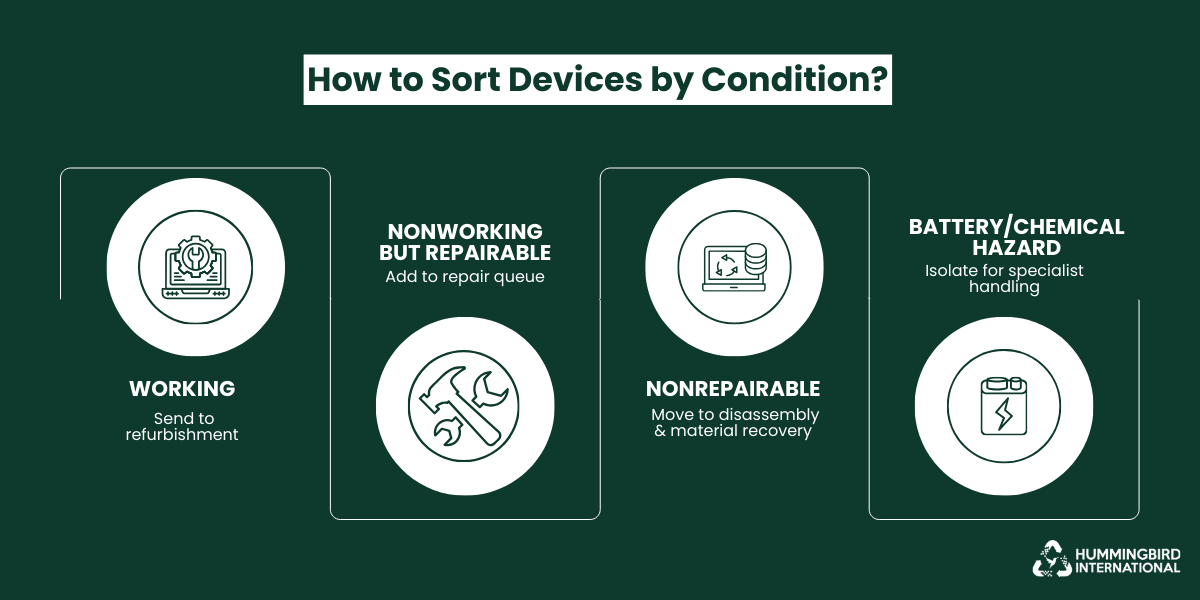
Sorting separates devices into paths that determine cost and handling. A clear sort reduces wasted labor and ensures repairable units are recovered rather than shredded.
- Main categories: Reusable, repairable, part-harvest, end-of-life, hazardous.
- Criteria: Device age, bootability, cosmetic and electrical condition, repair costs, resale potential, and data security requirements.
- Physical layout: Separate bays or pallets to prevent cross-contamination of streams.
- Outcome: Assignment to refurbishment, repair queue, disassembly line, or hazardous handling.
These are common device conditions and how to sort them:
Working machines → refurbishment,
Repairable nonworking → repair queue,
Nonrepairable → disassembly and material processing,
Battery or chemical hazard → isolation and specialist handling.
For businesses, this evaluation helps identify the most practical IT asset recovery option for each device. Working computers may be routed for internal redeployment or resale, while repairable units can undergo refurbishment before returning to use. Devices with no viable recovery value are headed for material recycling. This approach helps businesses extend equipment lifespan, recover value, and avoid recycling computers that could still serve a purpose.
Step 3: Data Destruction

Data destruction protects privacy and reduces liability. Recyclers follow standardized data methods and document each action to get rid of data on old hard drives.
- Logical wiping: Overwrite the storage media using certified software that meets accepted standards.
- Physical destruction: Shred or destroy storage devices when wiping is not possible or when the customer requires physical data destruction.
- Verification: Generate logs, sample audits, and link destruction records to serial numbers.
- Certificate proof: Provide customers with a certificate of data destruction or a detailed wipe report.
Let’s look at the most common data destruction methods and their use cases.
| Method | Use Case | Proof |
|
Software Wipe |
Functional HDD and SSD | Wipe report with hash or log |
|
Drive Degaussing |
High-sensitivity media | Degauss certificate |
|
Shredding |
Damaged or non-wipeable drives | Shred certificate with serials |
Learn about: Data Destruction and Device Disposal: The Ultimate Security Guide
Step 4: Parts Harvesting
Part harvesting extracts usable components to extend the computer’s life and reduce demand for new parts. Each recovered component is tested and graded.
- Common recovered parts: RAM, storage drives after sanitization, CPUs, power supplies, LCD panels, keyboards, and fans.
- Testing and grading: Components are bench-tested, labelled with a performance grade, and bagged with test notes.
- Reuse channels: Refurbishment builds, spare parts sales, education, or charity donation.
Harvesting increases circularity and improves the economics of recycling by delivering higher-value streams than raw materials alone.
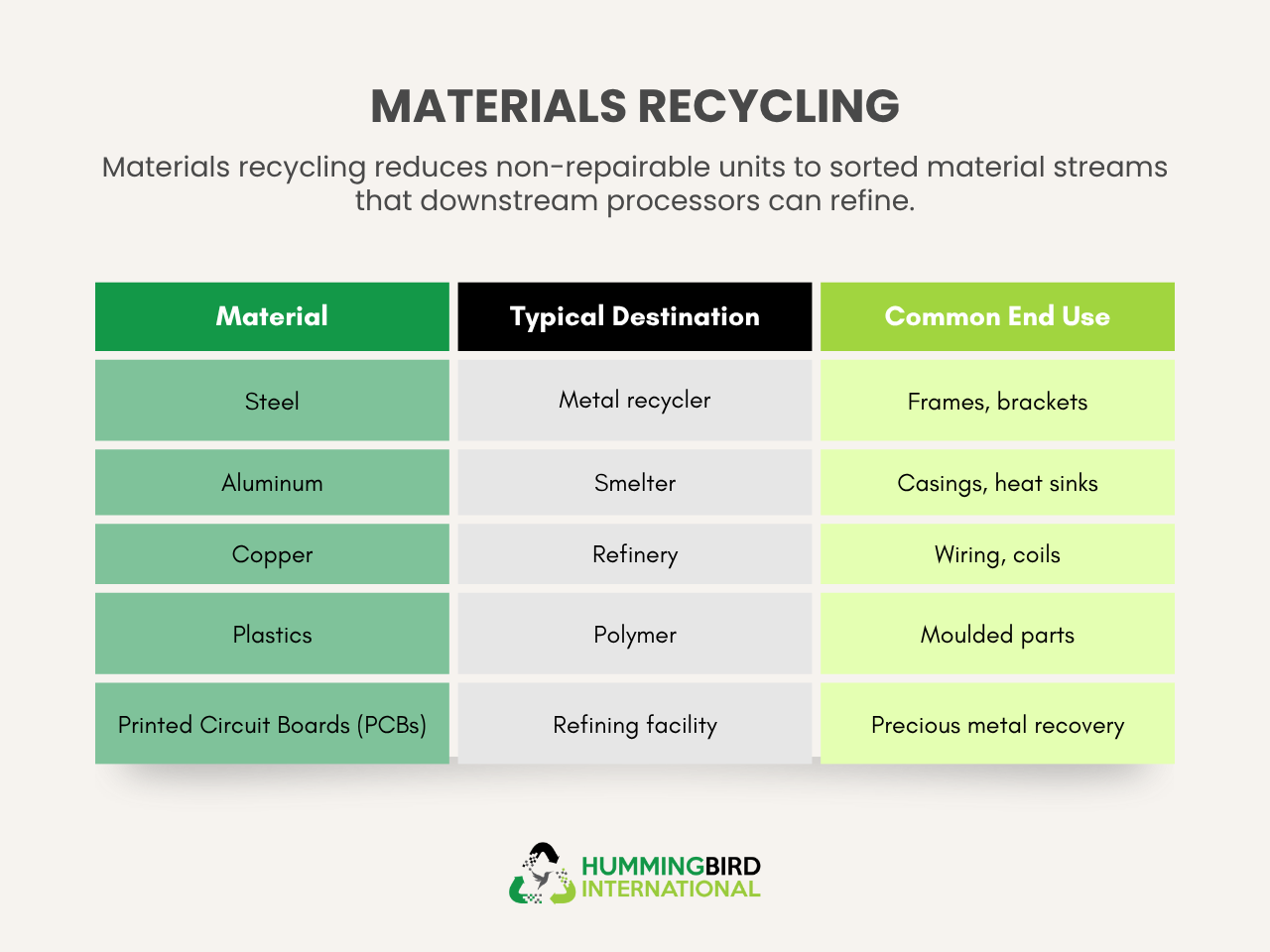
Step 5: Materials Recycling
Materials recycling reduces non-repairable units to sorted material streams that downstream processors can refine.
- Manual disassembly: Remove batteries, circuit boards, and large metal parts for separate handling.
- Mechanical processing: Shredding followed by separation using magnets, eddy currents, screens, and density methods.
- Downstream transfer: Certified processors and smelters receive sorted bales and feedstocks.
Step 6: Reporting
Reporting documents the fate of each item and provides businesses with evidence of compliance with e-waste legislation.
- Chain-of-custody entries show every handoff and process step.
- Data destruction certificates or wipe logs tie to serial numbers.
- Material recovery summaries show weights diverted from landfill and estimated recovery percentages.
- Business customers receive certificates for audit and sustainability reports.
Good reporting is the accountability mechanism that converts recycling activity into verifiable environmental performance.
Why Computer Recycling Matters Today
The world generated roughly 62 million tonnes of electronic waste in 2022 — from laptops and desktops to smartphones and cables — yet less than a quarter of that was properly collected and recycled.
That gap matters because every unrecycled computer device locks away metals, plastics, and other materials — and often allows hazardous substances to leak into the environment. Below are the major reasons why responsible computer recycling is critical today.
The Rise of E-Waste and the Strain on Natural Resources
Global e-waste continues to rise sharply, driven by shorter upgrade cycles and the massive growth of connected devices. What makes this surge notable is how it changes the role of old computers. They are no longer simply discarded office equipment. They now represent one of the largest pools of recoverable metals, plastics, and engineered materials available above ground.
Each generation of devices contains more complex components and more valuable elements, which means waste volumes are rising in both quantity and material density.
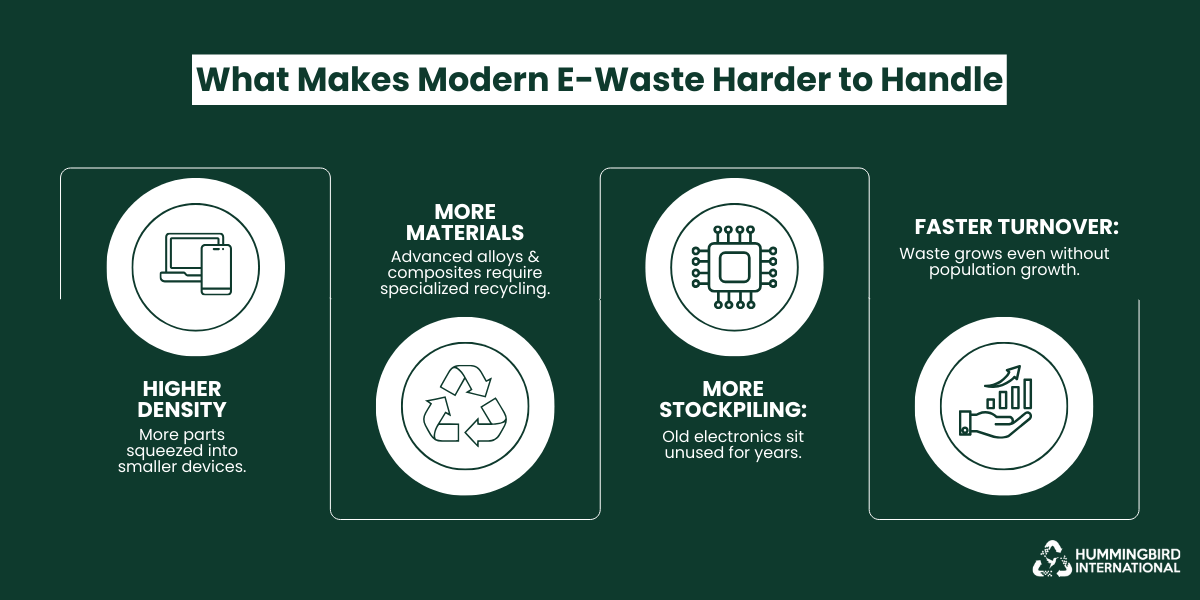
What sets today’s surge apart:
- Newer devices pack more components into smaller spaces, creating denser waste streams than in past decades.
- Modern hardware includes a wider mix of alloys, composites, and micro-materials that require advanced recycling techniques.
- Homes and businesses tend to stockpile old laptops and hard drives longer than other waste types, creating large, untouched reserves of recoverable materials.
- The speed of global device turnover creates a cycle where waste grows even when population growth slows.
These trends make computers one of the most important material resources of the modern era, and the e-waste recycling process has become essential not just for environmental reasons but for the practical management of this accelerating waste flow.
The Social Cost of Unsafe Dumping and Informal Disposal
Informal recycling and dumping of old computers and electronic waste often burden entire communities rather than solve the problem. When devices are dismantled in unregulated conditions, hazardous materials escape containment — and those living nearby pay the cost in health, environment, and social stability.
In many countries, the informal sector handles the bulk of e‑waste, despite the dangers. The consequences range from widespread pollution to long-term health risks for workers and residents.
Many well-known informal e‑waste hubs highlight how deep the problem runs.
- Agbogbloshie (Accra, Ghana) — Once among the largest e‑waste dumps globally, informal workers publicly burned and dismantled electronics to extract metals; soil and water contamination, plus serious health risks for locals, have been widely documented.
- Guiyu (Guangdong, China) — Known as the “electronic graveyard of the world,” this town processed massive amounts of discarded gadgets with minimal regulation; the work released toxic dust and heavy metals, impairing local air, water, and resident health.
Recognizing this social cost is a key reason why proper, certified recycling matters — not just for materials, but for people and communities too.
Learn More: The Actual Cost Of Recycling In The USA
Responsible Consumption and “Cleaner America” Goals
The idea behind a “cleaner America” centres on reducing pollution, protecting soil and water, and strengthening domestic material recovery so the country depends less on hazardous extraction. In the context of computers, this goal relies heavily on how devices are used, stored, and finally retired.
Responsible consumption encourages longer product lifecycles, careful disposal, and stronger recovery of metals already in circulation. These practices support national sustainability plans that aim to limit landfill pressure and reduce exposure to toxic components from discarded electronics.
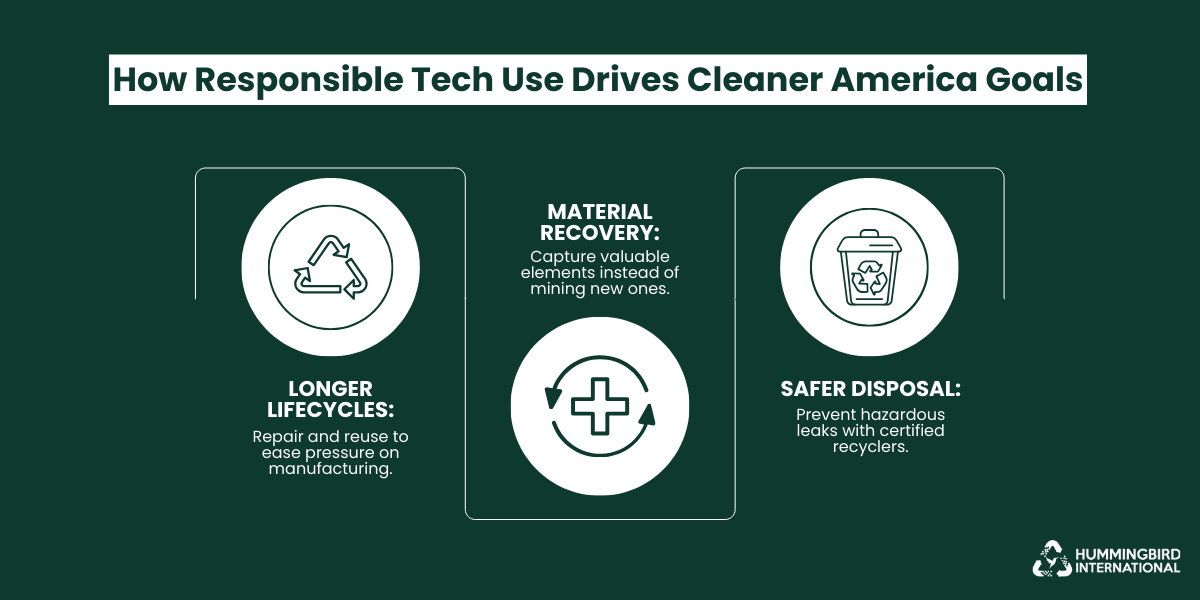
Key points that show how responsible use ties directly to the Cleaner America objectives include:
- Longer device lifecycles (repair, refurbish, second-life use) to ease strain on manufacturing.
- Recover valuable materials to reduce dependence on mined virgin resources.
- Lower hazardous leakage via better disposal standards and certified processing.
Certified Computer Recycling as a Trust Signal for ESG Reporting
Modern sustainability reporting expects firms to prove how they manage electronic waste, not simply state that equipment was “disposed of responsibly.” Certified computer equipment recycling and disposal gives companies that proof. It provides documented tracking, verified data destruction, and audited recycling routes, which together create a clear record that equipment was handled without harm to the environment or local communities.
For many organizations, this assurance supports broader goals:
- Accurate ESG disclosures, since certified ITAD partners supply measurable recovery rates and recycling outcomes.
- Lower environmental exposure, with hazardous components routed through approved downstream processors.
- Better resource efficiency, as firms recover value from old assets and often monetize IT assets instead of sending them to storage or landfill.
With a certified ITAD service provider like Hummingbird International, businesses strengthen their environmental profile and demonstrate that their technology footprint is managed with care.
Global volumes are rising faster than treatment capacity.
The UN projects e-waste to reach 82 million tonnes by 2030, yet only a small share enters documented recycling.
Unregulated exports remain common.
Electronics continue moving to regions with weak oversight, where burning and acid stripping release toxic by-products.
Escalating “invisible waste.”
Millions of devices sit unused in homes and offices, delaying material recovery and amplifying storage risks.
The global crisis reflects an urgent need for stronger collection systems, certified processing, and responsible IT recovery that protects communities while keeping valuable resources in circulation.
Conclusion
Recycling old computers is no longer a side task. It’s part of how we protect local communities, recover useful materials, and handle technology with a bit more care. If you’re looking for a straightforward way to clear out aging equipment without creating more waste, Hummingbird International LLC can take it from here through its computer disposal service.
Frequently Asked Questions (FAQs)
How do you prepare a computer for recycling or disposal?
Back up important files, sign out of personal and work accounts, and remove connected accessories for example USBs. Inquire your ITAD provider about removing asset tags. Arrange secure data wiping or certified drive destruction. Finally, pack the device safely, keeping damaged or swollen-battery computers separate and informing the recycling provider.
2. What is the difference between recycling and refurbishing?
Refurbishing keeps a device in use for longer. A computer is inspected, repaired, fitted with replacement parts if needed, and then resold or redeployed.
Recycling is different. It focuses on dismantling the device, removing data-bearing components, harvesting usable pieces, and processing the rest into raw materials.
Refurbishing preserves the whole device, while recycling extracts value from its individual parts.
3. Which computer parts can actually be recovered or reused?
Many components hold strong reuse or material value. Common recoverable parts include:
- Hard drives and SSDs, once wiped or shredded.
- RAM, power supplies, cooling fans, and other functional modules.
- Screens, keyboards, and casings, if they remain in good condition.
- Metals such as aluminium, copper, gold, palladium, and steel, recovered during shredding and separation.
These recovered parts strengthen circular supply chains and reduce the need for new resource extraction.
4. Do I need to wipe my device before sending it to a recycler?
With a certified ITAD or recycler, wiping isn’t required, as they securely erase or destroy all data. Many users still choose to delete personal files for peace of mind. Certified partners provide documentation confirming the safe destruction of data.
5. Can businesses track and verify how their computers were recycled?
Yes. Certified ITAD partners provide detailed reports and certificates showing each device’s journey — from data destruction to parts recovery and final recycling. This allows businesses to verify compliance, demonstrate sustainability efforts, and monetize retired IT assets where applicable.

