Most companies assume the hard part is wiping the drive. In reality, the bigger problem usually starts afterward, when an auditor asks for proof.
A missing serial number, incomplete chain-of-custody record, or vague destruction certificate can quickly turn a routine compliance review into a long back-and-forth. Even businesses with solid IT practices get flagged because their documentation does not clearly show what happened to each device.
That is one reason the NIST SP 800-88 purge certification has become such a major focus during audits. Companies are expected to show exactly how data was sanitized, who handled the device, and whether the process can actually be verified later.
The pressure is understandable. According to IBM’s Cost of a Data Breach Report, the average data breach now costs businesses millions of dollars globally. For auditors, weak sanitization records are often seen as an early warning sign rather than a paperwork issue.
- What Is NIST SP 800-88?
- The Three Sanitization Levels Defined by NIST SP 800-88
- Which Devices Require NIST SP 800-88 Sanitization?
- The Main Things Auditors Actually Look For
- Purge vs Physical Destruction: Which One Auditors Prefer
- How Businesses Can Stay Audit-Ready
- Final Takeaway
- Frequently Asked Questions
- 1. What does NIST SP 800-88 purge certification actually prove during an audit?
- 2. How is purge different from physical destruction under NIST SP 800-88 guidelines?
- 3. What documents are required to pass a NIST SP 800-88 compliance audit?
- 4. Can SSDs be securely sanitized using NIST SP 800-88 purge methods?
What Is NIST SP 800-88?
The National Institute of Standards and Technology created NIST Special Publication 800-88 as a set of guidelines for safely removing data from storage devices. The document is commonly referred to as “NIST SP 800-88” and has become one of the most recognized standards for media sanitization across both government and private organizations.
Even though it was originally written for federal agencies, businesses now use it as a practical benchmark for handling retired devices, failed drives, and equipment leaving secure environments. Instead of giving companies a one-size-fits-all rule, the standard explains different sanitization methods based on the type of media and the sensitivity of the data involved.
For auditors, NIST SP 800-88 matters because it creates a clear framework. It shows whether a company follows a documented process or simply relies on informal wiping practices.
The Three Sanitization Levels Defined by NIST SP 800-88
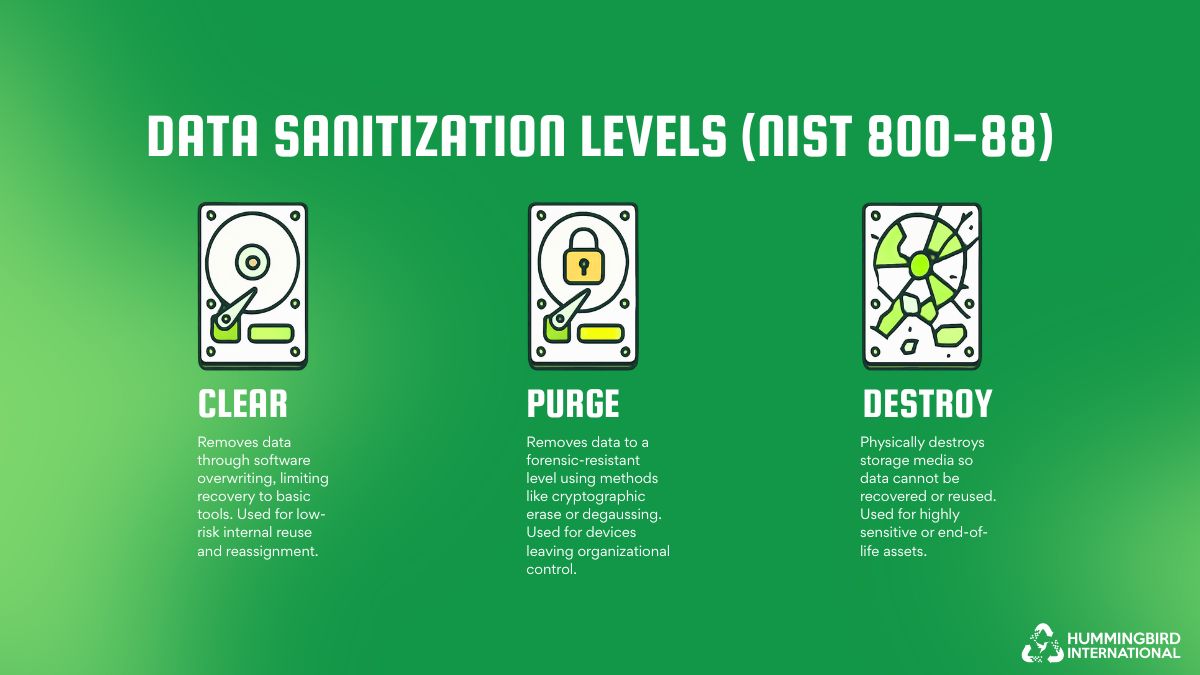
One reason the standard is widely used is that it separates data sanitization into three levels instead of treating every device the same way.
• Clear
The “Clear” method removes data through software-based techniques such as overwriting storage locations. It protects against basic recovery attempts using common tools, which makes it suitable for internal reuse where the risk level is lower.
Organizations often use Clear when devices stay inside the company and are reassigned to employees or departments.
• Purge
Purge goes further by making data recovery extremely difficult, even with advanced forensic methods. This is the level most companies focus on when devices are being sold, recycled, returned after leasing, or sent to third-party vendors.
Depending on the storage media, Purge may involve cryptographic erase, degaussing, or other approved sanitization techniques. Auditors usually pay close attention here because this stage carries the highest compliance risk for reusable devices.
• Destroy
Destroy physically damages the media, rendering it unable to function or store data. Once a device reaches this stage, reuse is no longer possible.
Methods can include shredding, crushing, disintegration, or pulverization. Companies handling highly sensitive financial, healthcare, or government data often choose destruction for failed drives or high-risk assets.
Which Devices Require NIST SP 800-88 Sanitization?
Any device that stores company, customer, or employee data should be included in a sanitization policy. One of the most common audit failures happens when businesses focus only on laptops and servers while ignoring smaller or less obvious storage devices scattered across the workplace.
Auditors usually expect companies to account for all data-bearing devices, including:
- Hard disk drives (HDDs): Standard mechanical storage devices widely used in desktops, servers, and older computer systems.
- Solid-state drives (SSDs): Require specialized sanitization methods because standard overwriting may not fully remove stored data.
- USB drives and flash media: Small, portable devices that are easy to lose and often contain sensitive files.
- Mobile devices: Smartphones and tablets may store emails, saved passwords, customer records, and synced company data.
- Backup tapes: Frequently used in enterprise environments for long-term data storage and disaster recovery.
- Printers and copiers: Many office machines contain internal drives that retain scanned documents and print history.
- Network equipment: Routers, switches, and firewalls can store logs, credentials, and configuration data long after deployment.
Also Read: A Complete Hard Drive Disposal Guide
The Main Things Auditors Actually Look For
A lot of companies think the audit ends once the drives are wiped. In reality, that is usually where the real scrutiny begins.
Auditors are not sitting there trying to recover deleted files from every hard drive. What they are actually checking is whether your organization followed a controlled, repeatable, and well-documented sanitization process from beginning to end.
That means they look at the paperwork, the tracking systems, the sanitization methods, the employee procedures, and the final certificates together as one complete chain of evidence.
According to NIST SP 800-88 Rev. 1, media sanitization is supposed to make data recovery “infeasible for a given level of effort.” In simple terms, companies need to prove they reduced the risk of data recovery to an acceptable level using approved methods and verifiable processes.
Here are the main areas auditors usually focus on during a review.
1. Clear Documentation
Documentation is normally the first thing auditors ask for because it tells them whether the organization actually has control over its sanitization process.
A proper sanitization record should allow someone to trace a device from the moment it leaves active use until its final disposition. If records are incomplete, inconsistent, or difficult to follow, auditors immediately start questioning the reliability of the entire process.
At a minimum, auditors expect to see:
- Asset serial numbers
- Device type and storage capacity
- Sanitization method used
- Processing date and time
- Technician or operator identification
- Final disposition status
The serial number part matters more than many companies realize. Auditors do not want vague statements like “50 drives sanitized.” They want proof tied to specific hardware.
For example, if a business claims a laptop drive was purged, the auditor should be able to match:
- The asset inventory
- The sanitization report
- The certificate
- The transportation records
- The final disposition status
all back to the same device.
Another common issue is inconsistent terminology. One report might say a drive was “wiped,” another says “destroyed,” and another says “formatted.” That kind of loose wording creates confusion fast because those terms do not mean the same thing under NIST guidelines.
Auditors also pay attention to timing. If the asset retirement date and sanitization date are weeks apart with no explanation, they may ask where the device was stored during that period and who had access to it.
2. Verified Sanitization Methods
This is where auditors start looking at the technical side of the process.
One major point in NIST SP 800-88 is that not every sanitization method works equally well for every storage device. Older HDDs, SSDs, flash storage, backup tapes, and mobile devices all behave differently.
Auditors want proof that the organization selected a method appropriate for the media type instead of using the same process for everything.
They typically review:
- Approved purge techniques
- Secure erase reports
- Cryptographic erase procedures
- Firmware-level sanitization records
- Degaussing logs
- Validation and verification reports
For traditional HDDs, overwriting may still be acceptable in certain situations. SSDs are different because data can remain in inaccessible storage cells even after overwriting attempts. That is why many SSD sanitization workflows rely on cryptographic erase or firmware secure erase functions instead.
Auditors also look for evidence that the sanitization actually worked.
NIST specifically discusses verification as an important part of the sanitization process. A company should not simply run a wiping tool and assume success. There should be some type of confirmation step afterward.
That verification may include:
- Automated pass/fail reports
- Spot-check sampling
- Validation scans
- Secondary review procedures
- Tool-generated erasure logs
This is where businesses often run into problems with outdated internal procedures. Some companies still rely on older habits or assumptions about how to destroy data safely without realizing that modern storage devices require different handling methods.
3. Tamper-Proof Audit Trails
Auditors care heavily about traceability.
If someone cannot clearly follow where a device went, who handled it, and what happened to it during processing, the organization loses credibility very quickly.
That is why audit trails are such a major focus.
Strong audit trails usually include:
- Timestamped intake records
- Barcode scanning systems
- Asset tracking software
- Processing logs
- Transportation records
- Final disposition confirmation
The goal is to create a record that cannot easily be altered later.
For example, if a technician manually edits spreadsheets after processing devices, auditors may question whether records were changed retroactively. Automated systems with timestamps and user logs are generally viewed as more reliable.
Many companies now use barcode-based workflows because they reduce human error and create a much cleaner chain of evidence during audits.
Auditors also compare records across departments. If IT inventory says a device still exists while the destruction vendor claims it was processed months ago, that mismatch becomes a serious issue.
4. Chain of Custody Records
Chain of custody is one of the biggest areas auditors examine during NIST-related reviews, especially when third-party vendors are involved.
Once devices leave secure internal control, auditors want to know exactly what protections remain in place during transportation, storage, and processing.
They typically ask questions like:
- Who collected the devices?
- Where were they stored?
- Were containers sealed?
- Who signed for the transfer?
- Was transportation documented?
- Did unauthorized people have access?
Good chain-of-custody documentation usually includes:
- Signed transfer records
- Pickup manifests
- Driver identification
- Secure storage procedures
- Timestamped handoff records
- Transportation tracking logs
This becomes extremely important during investigations tied to lost hardware or disputed data destruction and disposal claims.
A single missing handoff signature may not sound serious, but to an auditor, it creates uncertainty about whether the device was ever fully controlled during the process.
5. Failed Drive Handling Procedures
Not every drive can be successfully sanitized.
Some drives fail mechanically. Others become corrupted or inaccessible before the purge process completes. Auditors expect organizations to plan for these situations ahead of time instead of making decisions on the fly.
This area gets overlooked constantly.
Companies often document successful wipes very carefully but have weak procedures for failed media. Auditors notice that quickly because failed drives can become major security risks if they disappear from the workflow.
Auditors usually expect documented procedures covering:
- Failed or unreadable drives
- Incomplete sanitization attempts
- Escalation procedures
- Physical destruction requirements
- Exception reporting
- Final disposition verification
For example, if an SSD cannot complete a cryptographic erase process, the company should have a written policy explaining when the device moves to physical destruction instead.
There should also be records explaining:
- Why the purge failed
- Who approved the next action
- What destruction method was used
- When the final destruction occurred
Without those records, auditors may assume the organization lost visibility over the asset completely.
6. Certification Accuracy
Many businesses treat certificates like simple completion receipts. Auditors do not.
They compare certificates against inventory records, sanitization logs, transportation records, and asset databases to make sure everything matches correctly.
A proper Certificate of Destruction or sanitization certificate should normally include:
- Date and time of processing
- Sanitization method used
- Clear, Purge, or Destroy classification
- Device serial numbers
- Technician name
- Company certification details
- Chain-of-custody references
- Verification status
One of the biggest audit problems happens when companies issue generic batch certificates with almost no device-level detail.
For example:
“250 drives destroyed on May 12.”
It is usually not enough on its own.
Auditors increasingly expect certificates tied to individual assets so they can verify exactly what happened to each device.
They also commonly flag:
- Missing serial numbers
- Duplicate asset entries
- Incorrect device counts
- Mismatched dates
- Incomplete reports
- Contradictory status labels
This is one reason myths about ITAD still create confusion inside organizations. Many businesses assume the certificate alone is the proof, when auditors often see the certificate as only the summary layer sitting on top of the real evidence.
7. Employee and Vendor Accountability
Auditors do not only evaluate technology. They also evaluate the people and processes behind it.
Even the best sanitization tools become unreliable if employees are poorly trained or vendors follow inconsistent procedures.
That is why auditors often review:
- Employee training records
- Internal sanitization policies
- Standard operating procedures
- Vendor certifications
- Access control policies
- ITAD compliance documentation
If a third-party vendor handles sanitization, auditors may ask whether the company verified that the vendor’s processes align with NIST recommendations.
They may also review whether employees actually follow internal procedures consistently or simply improvise when processing devices.
This is especially important in environments handling healthcare data, financial records, government contracts, or customer information at scale.
A mature sanitization program usually shows consistency everywhere:
- The policies match the procedures
- The procedures match the reports
- The reports match the inventory
- The inventory matches the certificates
When those pieces line up cleanly, audits become much easier to defend.
Purge vs Physical Destruction: Which One Auditors Prefer
Auditors do not automatically prefer physical destruction. What they actually look for is whether the chosen method fits the risk level of the data and whether the process is properly documented under NIST SP 800-88. In many cases, a verified purge is enough, especially when devices are reused or resold through controlled channels.
When Purge Is Acceptable
Purge is usually approved when the organization can prove that data recovery is not feasible and the process is properly validated. Auditors are generally satisfied when there is clear documentation and strong traceability.
Common situations include:
- Devices being redeployed within the organization
- IT equipment sold through certified vendors
- Lease return hardware
- Standard enterprise refresh cycles
- SSDs and HDDs processed with approved NIST methods and verification logs
The key factor is evidence. If the sanitization method is supported by logs, asset tracking, and verification reports, purge is typically acceptable.
When Physical Destruction Becomes Mandatory
Physical destruction is used when the risk level is too high or when sanitization cannot be reliably confirmed. In these cases, auditors expect full destruction records rather than purge certificates.
Common triggers include:
- Highly sensitive or regulated data environments
- Failed or damaged drives that cannot be sanitized
- Devices where purge results cannot be verified
- Regulatory or contractual requirements requiring destruction
- Classified or mission-critical data systems
Once destroyed, the media is no longer usable, which removes any chance of recovery but also eliminates reuse value.
How Data Sensitivity and Industry Rules Affect the Decision
The choice between purge and destruction is heavily influenced by the type of data and the industry involved. A general office environment has far more flexibility than sectors handling regulated or confidential information.
Healthcare, financial services, government contractors, and defense-related organizations often face stricter expectations. In some cases, contracts or compliance rules explicitly require destruction, even if purge methods would technically be sufficient.
Auditors focus less on preference and more on justification. If the decision aligns with risk level and regulatory requirements, it is usually accepted.
NIST SP 800-88 vs Other Standards
| Standard | Focus | Audit Strength | Typical Use Case | Key Limitation |
| NIST SP 800-88 | Risk-based media sanitization with a clear Clear/Purge/Destroy framework | Very strong, widely accepted in audits | Corporate, government, and regulated industries | Requires detailed documentation and verification |
| ISO/IEC 27001 | Information security management system controls | Strong at the system level, not device-specific | Organization-wide security governance | Does not define detailed sanitization steps |
| DoD 5220.22-M (legacy) | Older wiping-based sanitization approach | Limited acceptance in modern audits | Legacy environments | Considered outdated for many modern storage types |
| Internal company policies | Organization-defined procedures | Varies widely | Small to mid-size businesses | Often weak without alignment to formal standards |
In most modern audits, NIST SP 800-88 is treated as the practical benchmark because it connects policy, method, and proof in a way auditors can actually verify.
How Businesses Can Stay Audit-Ready
Most audit issues do not appear suddenly. They build up over time through inconsistent processes, missing records, and weak visibility over device handling. Strong audit readiness comes from structure, discipline, and making sure every step in the sanitization process is traceable. It also helps reduce hidden cybersecurity risks that often go unnoticed until an audit exposes them.
- Standardizing Sanitization Workflows: Define one consistent process for every device type, from collection to final sanitization and approval.
- Automating Reporting and Asset Tracking: Use tracking systems that automatically record each device’s movement, status, and sanitization outcome.
- Running Internal Compliance Checks: Regularly review a sample of completed cases to ensure records match actual processes and policies.
- Keeping Documentation Organized and Accessible: Store all audit records in a single structured system where each asset can be quickly traced and verified.
Final Takeaway
Auditors are not looking for claims; they are looking for proof that holds up under review. NIST SP 800-88 gives them a clear way to evaluate whether data has been properly handled, documented, and verified. Whether an organization uses purge or destruction, the real test is consistency across records, methods, and the chain of custody. When those pieces align, compliance becomes far easier to defend during any audit.
Frequently Asked Questions
1. What does NIST SP 800-88 purge certification actually prove during an audit?
It proves that an organization has followed a recognized sanitization process and can show evidence that data on a device has been rendered unrecoverable. Auditors look for supporting records such as asset tracking, method details, and verification logs, not just a final certificate. The focus is on whether the process is traceable, consistent, and properly documented from start to finish.
2. How is purge different from physical destruction under NIST SP 800-88 guidelines?
Purge removes data in a way that makes recovery infeasible while keeping the device usable. Physical destruction permanently disables the media so it cannot be reused. Auditors accept both approaches, but purge requires strong verification and documentation, while destruction is usually used when risk levels are higher, or reuse is not allowed.
3. What documents are required to pass a NIST SP 800-88 compliance audit?
Auditors typically expect a complete set of records that includes asset serial numbers, the sanitization method used, chain-of-custody documentation, processing dates, technician identification, and final disposition certificates. Missing or inconsistent records are one of the most common reasons companies face audit issues.
4. Can SSDs be securely sanitized using NIST SP 800-88 purge methods?
Yes, SSDs can be sanitized under NIST SP 800-88, but they require the correct method. Techniques like cryptographic erase or firmware-based secure erase are commonly used instead of traditional overwriting. Auditors look for proof that the method matches the storage type and that verification steps confirm successful sanitization.