Managing electronic waste is challenging for any organization. For companies operating across multiple offices, cities, or regions, it can become more complex than usual. Different devices, varied disposal requirements, scattered teams, and inconsistent processes can quickly turn e-waste management into an overwhelming burden. Yet as businesses adopt more digital tools and upgrade hardware more frequently, responsible e-waste handling is no longer optional. It’s a compliance requirement, a sustainability priority, and a core operational responsibility.
The good news? With the right strategy and the right recycling partner, multi-location e-waste pickup can become predictable, secure, and streamlined.
- What is E-Waste Management?
- Why Consider E-Waste Pickup for Multi-Location Businesses?
- How to Simplify E-Waste Pickup for Multi-Location Businesses
- Conduct an E-Waste Audit for Multiple Sites
- Choose the Right Pickup Model
- Partner with a Recycler Certified for Multiple Locations
- Set Up Internal Collection Points
- Define Data Security Protocols
- Data Security Protocols for Multi-Location Businesses
- Consolidate Reporting for all Locations
- Continuously Review, Optimize, and Scale
- Benefits of a Multi-Location E-Waste Pickup
- Case Study: How a Retail Giant Unified E-Waste Management Across 50 Stores?
- Case Study: How a Financial Firm Safeguarded Client Information with Standardized E-Waste Management?
- Case Study: How a Healthcare Provider Streamlined Recycling Across Multiple Clinics?
- Case Study: How a Tech Company Simplified Multi-Location E-Waste Management?
- Case Study: How a B2B SaaS Company Strengthened Sustainability and Brand Credibility?
- Frequently Asked Questions
- 1. How many times should multi-location businesses schedule e-waste pickups?
- 2. What types of electronics are accepted in a multi-location e-waste pickup program?
- 3. How can businesses maintain data security when disposing of devices across multiple offices?
- 4. Is it more cost-effective to use one recycler for all locations instead of multiple local vendors?
- 5. What are the biggest challenges companies face when managing e-waste across multiple offices?
What is E-Waste Management?
This refers to the proper handling, collection, transportation, recycling, and disposal of electronic waste. E-waste includes computers, laptops, phones, printers, cables, batteries, servers, networking equipment, and more.
Think of it as a full lifecycle process where old electronics are dealt with safely, responsibly, and in compliance with environmental standards. You also don’t have to worry about data security breaches, as all important information is removed with protocols beforehand.
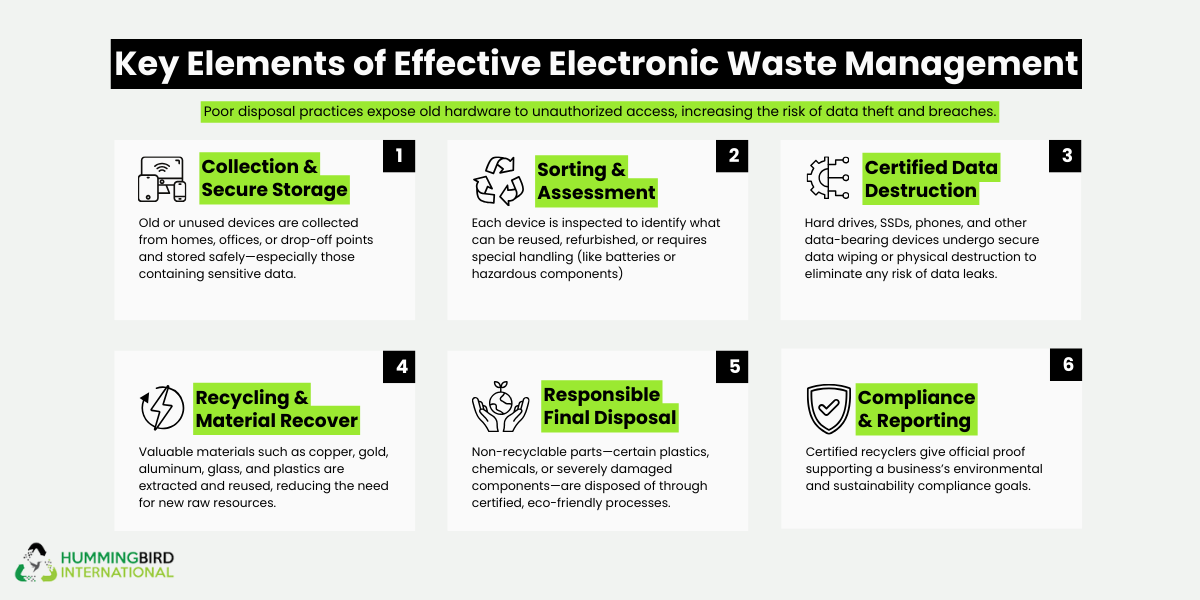
Here are some key elements of e-waste management.

-
Collection and Storage
It mainly includes gathering old or unused electronic devices from homes, offices, or collection centers and storing them securely. For devices that have sensitive data, a certified e-waste pickup service has an extensive storage process to prevent any issues later on.
-
Sorting and Assessment
Devices are examined to determine what can be reused, refurbished, or requires specialized disposal (such as batteries or hazardous components).
-
Data Destruction
Hard drives, SSDs, phones, and other data-bearing devices go through secure data erasure or data destruction, sometimes physical as well, to prevent data breaches.
-
Recycling and Material Recovery
Electronics are also used to extract valuable materials like copper, gold, aluminum, glass, and plastics. These materials can work for manufacturing companies, reducing the need for new resources.
-
Responsible Disposal
There are a few components of electronics that cannot be recycled, such as certain plastics, chemicals, or damaged parts. They are disposed of using certified, eco-friendly methods to avoid soil and water contamination.
-
Compliance/Reporting
Certified recyclers issue documentation such as certificates of recycling or destruction, helping businesses meet environmental regulations and sustainability reporting requirements.
Why Consider E-Waste Pickup for Multi-Location Businesses?
Multi-location companies, from retail chains to corporate offices, have to manage e-waste from devices like computers, printers, routers, POS systems, servers, and even broken cables. Securely disposing of electronics from multiple branches can be quite difficult without a certified e-waste partner.
-
Logistical Challenges
Coordinating pickups from scattered locations can result in delays, inconsistent shipments, and unsafe storage of unused electronics. With a scalable strategy, it’s easier to make sure that all the locations follow the same schedule and protocols.
-
Data Security Risks
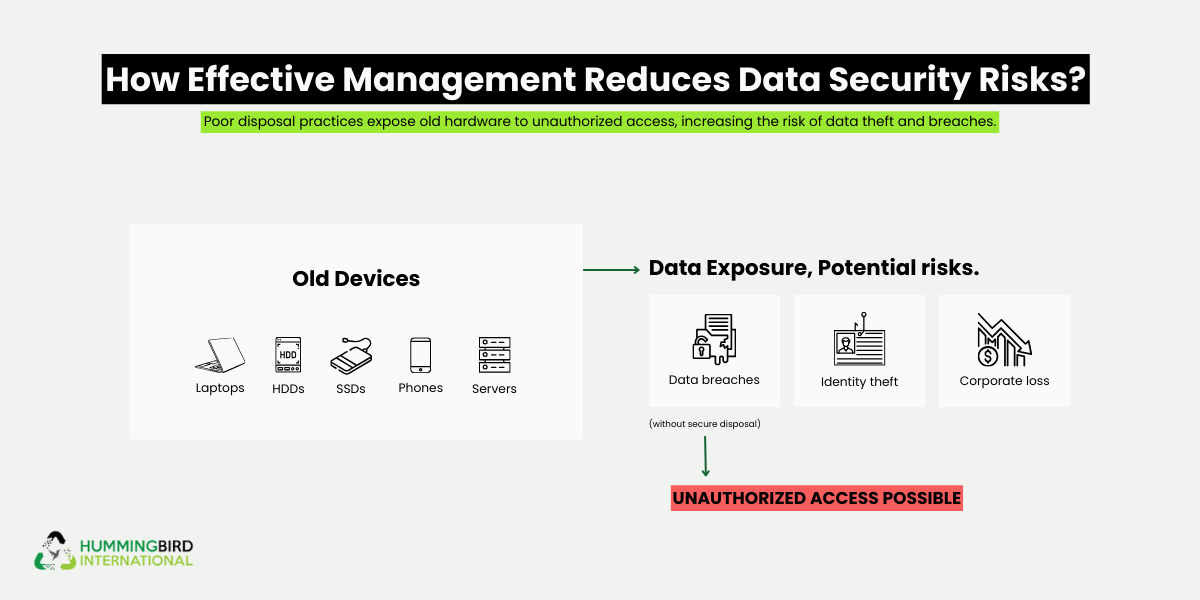
Devices like laptops and servers may contain sensitive or proprietary data. Without secure disposition and data destruction, businesses face the risk of data breaches. This can be avoided with proper e-waste management and disposal.
Sensitive information stored on devices like hard drives, laptops, servers, and smartphones is completely wiped or destroyed before recycling or refurbishing. A certified e-waste pick service uses secure data-erasure or physical destruction methods to prevent unauthorized access, identity theft, and corporate espionage.


-
Compliance Requirements
Different regions have their own e-waste regulations. Laptop recycling across the world requires compliance with laws that may be quite different than the ones we are used to. It’s important for multi-location brands to also comply with regulations where they are based.
| State | Key E-Waste Recycling Requirements | What Businesses Should Do |
| California | Covered Electronic Waste (CEW) program, many devices (TVs, monitors, computers, large displays) have disposal restrictions and recycling-fee requirements; the state maintains approved collectors/recyclers. | Use CalRecycle-listed collectors, avoid landfill disposal of CEWs, collect and retain recycling receipts and manifests. Monitor CEW fee rules and compliance updates. |
| Maine | EPR (producer responsibility) program covering many electronics, small businesses (and households) must use approved recycling channels; recordkeeping requirements apply. | Route devices to Maine-approved recyclers and retain documentation (often 3 years). Verify whether your business falls under ‘covered entity’ limitations. |
| Maryland | State law requires proper recycling of covered electronics (manufacturer/collector programmatic obligations). | Work with licensed recyclers, maintain disposal records, and check county-level rules where applicable. |
| Washington (WA) | E-cycle Washington: landfill/solid-waste bans on covered electronics and manufacturer take-back programs. | Use e-cycle approved collection points or recyclers. Don’t landfill covered devices and request certificates of recycling. |
| Connecticut (CT) | Landfill/incineration ban for many electronics, manufacturer/retailer registration, and recycling programs. | Send business e-waste to approved recyclers, keep manifests/certificates for audits. |
| Minnesota (MN) | Manufacturer-funded recycling system for video display devices, computers, and electronics. Disposal restrictions apply. | Use state channels or registered recyclers, document disposition, and verify the covered-device list. |
| Oregon (OR) | Manufacturers take-back access for TVs, monitors, and computers. Landfill bans for covered devices. | Route business e-waste to approved take-back or recycler programs, preserve chain-of-custody docs. |
| Texas (TX) | Industrial take-back programs and state guidance for covered devices. Disposal/recycling obligations for many electronics. | Use manufacturer take-back options or certified recyclers. Confirm any registration/manifest needs for high volumes. |
| North Carolina (NC) | The law prohibits landfilling many covered electronics and encourages recycling via approved programs. | Use authorized recyclers, track receipts and manifests, especially for large decommissions. |
| New Jersey (NJ) | Covered devices (computers, TVs, monitors) are banned from landfill, and manufacturer/collector programs in place. | Make sure business devices enter certified recycling streams and maintain documentation for compliance. |
| Oklahoma (OK) | State law governs the disposal of covered computer equipment. Manufacturers or collection programs are involved. | Use authorized take-back or recycler programs and retain records of disposal actions. |
| Virginia (VA) | Restrictions on landfill disposal for certain electronics, manufacturer/retailer responsibilities exist. | Route equipment through approved recyclers, especially watch CRT/ hazardous-component rules. |
| West Virginia (WV) | State e-waste rules require proper recycling/disposition of covered electronics and landfill bans for some devices. | Use certified recyclers, ask for recycling certificates, and comply with hazardous-component handling rules. |
| Missouri (MO) | State-level e-waste rules for typical covered devices, disposal restrictions apply. | Businesses must send covered electronics to approved recycling channels and keep records. |
| Hawaii (HI) | State law requires manufacturers to implement take-back programs for TVs/computers, and disposal restrictions are enforced. | Use manufacturer or certified recycler programs. Island logistics mostly require scheduled pickups, so plan ahead. |
| Rhode Island (RI) | Disposal bans for TVs, monitors, and computers, and recycling programs are required. | Route e-waste to authorized recyclers, keep manifests for corporate audits. |
| Illinois (IL) | Consumer Electronics Recycling Act: specified electronics banned from trash/landfills, manufacturers fund recycling. | Use manufacturer or certified recycler channels. Ensure recordkeeping and avoid landfill disposal. |
| Michigan (MI) | State law and guidance on electronics recycling, special rules on CRTs/ hazardous components. | Route covered devices to compliant recyclers, follow hazardous-waste handling for CRTs and batteries. |
| Indiana (IN) | Disposal bans on many covered devices and manufacturer take-back programs. Recycling required. | Use approved recycling programs, obtain certificates of recycling/destruction for records. |
| Wisconsin (WI) | Restrictions on landfill disposal for covered electronics. Recycling programs and manufacturer involvement. | Use authorized recyclers. track manifests and certificates for compliance. |
| Vermont (VT) | Broad ban on landfilling electronics; statewide recycling or take-back requirements for covered devices. | Send business e-waste to registered recyclers, maintain documentation and hazardous-component compliance. |
| South Carolina (SC) | Landfill bans and recycling programs for covered electronics, take-back frameworks exist. | Use certified recyclers, record disposal activity and check for municipal variations. |
| New York (NY) | Electronic Equipment Recycling & Reuse Act, manufacturers must provide recycling access, businesses must use certified recyclers and report in some cases. | If selling electronics, register/report with NYSDEC; if disposing, use certified recyclers and get recycling/destruction certificates. |
| Pennsylvania (PA) | Manufacturer take-back programs and disposal restrictions on covered electronics. | Coordinate with manufacturer programs or certified recyclers, keep recycling manifests for audits. |
| Utah (UT) | Product stewardship/recycling programs covering certain electronics and state guidance on disposal. | Use approved recycling channels, confirm whether manufacturer take-back or local programs apply. |
| District of Columbia (D.C.) | Local e-waste rules prohibit the disposal of many electronics in trash. Government/collector programs exist. | Use D.C. e-cycling options or certified recyclers, keep certificates, and follow local drop-off rules. |
-
ESG & Sustainability Reporting
Companies with ambitious environmental targets need accurate recycling data. A multi-location program provides unified documentation across all offices. A scalable approach not only simplifies disposal, it strengthens brand reputation, supports ESG goals, and reduces risk.
How to Simplify E-Waste Pickup for Multi-Location Businesses
The key to simplifying the process is creating a streamlined, predictable, and centrally controlled system that works regardless of how many branches you operate.
Here are a few ways to make e-waste pick for multi-location businesses smooth and hassle-free.

-
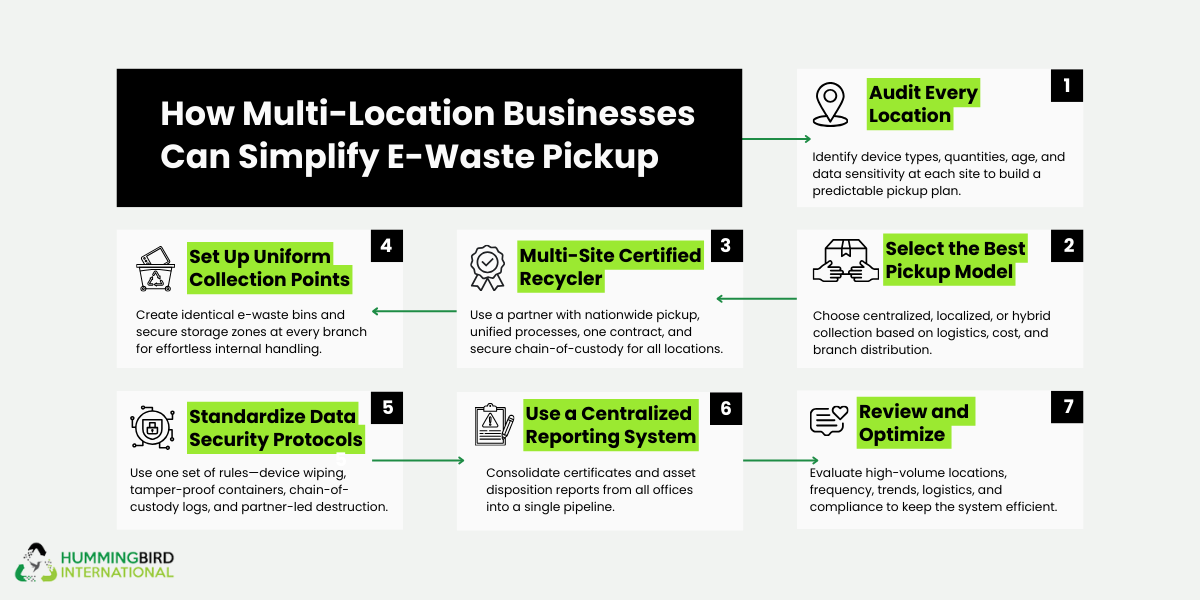
Conduct an E-Waste Audit for Multiple Sites
The first step is understanding exactly what you’re dealing with. A multi-location audit reveals the volume, type, and condition of devices at each site. These can be laptops, servers, monitors, POS systems, networking equipment, batteries, or any other electronic machines.
As you audit each location, go beyond just the simple details. Record the age, operational status, and data sensitivity level of each item. This allows you to identify which locations bring in more e-waste, or which offices hold devices with confidential information. You can also list down places where special materials (like lithium batteries or medical electronics) require unique handling. A clear audit prevents last-minute surprises and shapes a predictable, site-specific pickup plan.
-
Choose the Right Pickup Model
It is a lot easier to simplify e-waste management once a suitable model has been chosen. Mostly, there are two and you can look through any guide to finding an ITAD service partner to understand this in-depth.
-
Centralized Collection Model

Each branch gathers outdated electronics and sends them to a central facility (like the headquarters or main warehouse). From there, a recycling partner performs a single bulk pickup. This model works best for companies with strong internal logistics or existing inter-office courier systems.
-
Localized Pickup Model

The e-waste recycler visits each location directly on a scheduled route. This removes internal coordination burdens and allows for timely pickups from remote or high-volume sites.
Choose a model that reduces internal traffic, lowers transportation cost, and eliminates bottlenecks. Many companies also use a hybrid approach, centralized for urban clusters, localized for remote branches.
-
Partner with a Recycler Certified for Multiple Locations
Keep in mind that not every recycler is equipped to handle multi-site operations. And this can lead to quite a few challenges. When looking to simplify multi-location pickup for businesses, it is crucial to work with a certified e-waste partner that offers:
- Nationwide or region-wide pickup capabilities
- A dedicated account manager to coordinate all sites
- Standardized procedures across every location
- One contract, one billing system, and unified reporting
- Secure chain-of-custody documentation for sensitive devices
When one partner handles every office instead of multiple vendors with different rules, you don’t have to worry about miscommunication or inefficient disposal of e-waste.
-
Set Up Internal Collection Points
The goal is to make e-waste disposal as effortless as throwing something into the correct bin. No confusion, no guesswork, no delays. Setting up identical collection zones at each site means employees always know what to do, regardless of the location they work from or visit. This uniformity minimizes training needs and helps businesses make sure that the correct procedures are followed every time.

To achieve this, every office should be equipped with secure, clearly labeled bins specifically for general e-waste. Along with a designated locked room or cabinet for data-focused devices requiring extra security. Each location must also provide clear instructions on what items qualify as e-waste and clear guidelines for handling batteries and other hazardous components.
-
Define Data Security Protocols
Data security is the biggest complexity in e-waste disposal, especially across many offices. Simplify the process by defining one set of company-wide rules, such as:
- Requiring local IT teams to wipe devices before placing them in secure bins
- Mandating that all data destruction be handled exclusively by the recycling partner
- Using tamper-proof containers for laptops, servers, phones, and drives
- Making sure that a chain-of-custody log follows each device from pickup to destruction
When the protocol is standardized, employees do not have to interpret different rules across every location.
Data Security Protocols for Multi-Location Businesses
| Protocol | Why It Matters | Business Actions to Implement |
| Centralized Data Governance Policy | Ensures all locations follow the same rules for handling, storing, and disposing of data. | Create a unified data-handling manual. Assign a data compliance officer and train all branches. |
| Standardized Device Disposal Procedures | Prevents inconsistent disposal that could lead to data leaks at vulnerable locations. | Require all sites to wipe, degauss, or destroy drives before transport; document disposal steps. |
| End-to-End Encryption | Protects data in transit between branches and headquarters. | Implement encrypted email, secure file-transfer tools, and VPNs for all communication. |
| Role-Based Access Control (RBAC) | Limits access to sensitive data so only authorized personnel can view or modify it. | Set up user permission tiers; regularly audit login and access logs. |
| Multi-Factor Authentication (MFA) | Reduces login-related breaches across locations with varying security maturity. | Require MFA on all business accounts, cloud apps, and admin systems. |
| Asset Tracking & Chain of Custody | Ensures devices with data are never lost during transfers or pickups. | Use barcode/RFID tagging, maintain logs from device assignment to disposal. |
| Secure Transport for E-Waste | Prevents theft or tampering during movement to recyclers or shredding facilities. | Work with certified vendors, sealed containers, and documented pickup/drop-off. |
| Regular Data Wiping & Verification | Ensures no device leaves a location with recoverable data. | Use NIST-approved wiping software; require wipe certificates from recyclers. |
| Incident Response Plan (IRP) | Allows fast action if a breach happens at any site to limit damage. | Create reporting workflows, train all locations and run annual response drills. |
| Employee Cybersecurity Training | Reduces human-error breaches in distributed teams. | Quarterly training on phishing, device handling and disposal protocols. |
| Compliance Monitoring System | Helps every branch meet federal, state, and company-wide security rules. | Use automated compliance software, run monthly audits and keep centralized records. |
| Third-Party Vendor Vetting | Prevents risk introduced by recyclers, IT partners, or logistics companies. | Require R2/RIOS-certified recyclers. Review vendor security policies, sign data-protection and agreements. |
| Secure On-Site Storage for Retired Devices | Prevents unauthorized access before pickup. | Lock retired electronics in controlled rooms, restrict access and log entries. |
| Cloud Backup & Redundancy Controls | Protects data from loss anywhere in the organization. | Standardize cloud storage; enable automatic backups; encrypt backups across regions. |
| Location-Specific Risk Assessments | Accounts for varying threat levels at different sites. | Assess each branch annually; tailor protocols based on risk; update policies regularly. |
-
Consolidate Reporting for all Locations
One of the biggest pain points for multi-location businesses is managing endless certificates, emails, receipts, manifests, and compliance documents from different branches. To make this easier, it is important to create and maintain a single reporting pipeline. This is where you can request your e-waste pickup service to provide unified asset disposition reports covering all offices.
Look for digital certificates of recycling and destruction as well as device-level tracking for equipment that has critical data. There are also environmental impact summaries provided that can show compliance for all locations. This central documentation system not only simplifies internal compliance but also supports ESG (environmental, social, governance) reporting, CSR initiatives, and sustainability audits.
-
Continuously Review, Optimize, and Scale
As your business grows or restructuring occurs, adjusting the program prevents complexity from returning and allows the system to scale effortlessly. Simplifying e-waste pickup is an ongoing process, so conduct annual or biannual reviews to evaluate:
- Which locations generate the most e-waste
- If certain offices need more frequent pickups or not
- Seasonal spikes in electronics disposal (often tied to equipment refresh cycles)
- Transportation or scheduling inefficiencies
- Employee compliance and awareness levels
- Opportunities for cost reduction or consolidation
Benefits of a Multi-Location E-Waste Pickup
When businesses streamline how electronics are collected, stored, transported, and recycled, they can enjoy long-term advantages that impact their bottom line and brand reputation. Let’s take a look at some of the key benefits.
-
Stronger ESG Performance
A well-structured, multi-location e-waste management system directly supports a company’s Environmental, Social, and Governance (ESG) goals. With responsible disposal, material recovery, and reduced landfill contribution, businesses show progress toward sustainability metrics.
Case Study: How a Retail Giant Unified E-Waste Management Across 50 Stores?

A nationwide retail chain with 50 stores across different locations needs to collect data on ESG goals to make sure they are in compliance.
Business Challenge
They struggled to gather accurate sustainability data because each store was using different disposal methods. This led to inaccurate ESG and takes more time too.
Solution
Once it implemented a coordinated e-waste pickup program, all 50 stores had the same partner and process. The company received consolidated recycling certificates and diversion reports, allowing it to showcase improvements in environmental performance for investors, consumers, and compliance teams.
-
Reduced Data Security Risks
E-waste is one of the most overlooked sources of data breaches, especially when multiple offices store old electronics inconsistently. A streamlined program makes it easier for every location to follow the same strict data handling protocol. This minimizes the chances of sensitive information ending up in unauthorized hands, be it from outdated laptops, hard drives, printers, or networking devices.
Case Study: How a Financial Firm Safeguarded Client Information with Standardized E-Waste Management?

One large financial services firm with multiple regional offices had outdated laptops and hard drives stored in unlocked cabinets, sometimes for months.
Business Challenge
This created serious vulnerabilities and concerns about client data being mishandled or lost during office transitions.
Solution
They executed a standardized e-waste management program so every location could follow strict chain-of-custody procedures. All devices were locked in a secure collection bin until the certified recycler picked them up.
-
Greater Operational Efficiency
Fragmented e-waste handling leads to cluttered storage rooms, missed pickups, and confusion among staff. A centralized, standardized system eliminates such issues. Employees know exactly where to place old electronics, so there’s no need to arrange last-minute pickups, and internal logistics teams gain predictable workflows.
Case Study: How a Healthcare Provider Streamlined Recycling Across Multiple Clinics?

In the healthcare industry, a provider with clinics based across several cities required an easy solution to recycling and e-waste disposal.
Business Challenge
They had to manage storage rooms overflowing with old monitors, printers, and medical equipment. And this is where a lot of time was wasted as the staff figured out where to store items or schedule pickups separately. It also disrupted workflows for healthcare providers.
Solution
The organization created consistent internal collection points and a regulated pickup schedule for all clinics. It made e-waste pickup a smooth process and helped them save time as well.
-
Cost Savings Over Time
Emergency pickups, improper storage, and using multiple vendors can drive up disposal costs significantly. A unified multi-location system consolidates these expenses, allowing companies to negotiate better rates, reduce unnecessary transportation, and optimize pickup frequency based on actual waste generation patterns.
Case Study: How a Tech Company Simplified Multi-Location E-Waste Management?

A mid-sized tech company uses different e-waste vendors for their locations, and prices vary. They usually go with different pickup services for their offices.
Business Challenge
They faced issues when a sudden pickup led to unexpected costs, and some vendors also charged extra for data destruction.
Solution
By switching to a multi-location e-waste recycling service, this issue was resolved. The company is able to negotiate volume-based pricing and does not have to worry about emergency fees.
-
Improved Brand Reputation
A streamlined e-waste pickup system signals that your organization takes sustainability, data security, and compliance seriously. For customers, this strengthens trust. For employees, it brings pride and builds a culture of environmental responsibility.
Case Study: How a B2B SaaS Company Strengthened Sustainability and Brand Credibility?

One B2B SaaS company with different offices positioned itself as environmentally responsible and follows sustainability practices as well.
Business Challenge
Old electronics were piling up in offices, making it difficult to show recycling documentation to stakeholders and clients. This could harm brand credibility in the long run.
Solution
Once they decide to simplify e-waste pickup for their multiple locations, this changes. A reliable partner helps the company keep track of e-waste from every office and receive certificates of destruction as well as recycling summaries. This data can be added to marketing materials, CSR reporting, and client proposals.
Make your multi-location e-waste pickup simpler!
With a structured system, businesses can minimize risks and follow sustainable practices. By partnering with a certified e-waste pickup service, companies gain full visibility and control over their e-waste disposal.
Managing e-waste across multiple office locations doesn’t have to be overwhelming. As you choose a pickup service, the result is a more efficient organization that protects its data and reduces its environmental impact.
Frequently Asked Questions
1. How many times should multi-location businesses schedule e-waste pickups?
Most small to mid-sized businesses schedule quarterly or bi-annual pickups, while tech-heavy companies need them on a monthly basis. Pickup frequency depends on the size of each office, the volume of electronics used, and the turnover rate of devices. A good recycler will help assess your needs through an initial audit.
2. What types of electronics are accepted in a multi-location e-waste pickup program?
Certified e-waste recyclers accept computers, monitors, laptops, printers, networking equipment, phones, cables, batteries, and other IT assets. Some may also handle medical devices, POS systems, or large equipment. Ask beforehand, especially for batteries, hazardous materials, and devices with confidential data.
3. How can businesses maintain data security when disposing of devices across multiple offices?
Implement a standardized data security protocol that every location follows. This includes secure storage bins, asset tagging, chain-of-custody documentation, and certified data wiping or destruction. Always choose a recycler that offers verifiable shredding, degaussing, or secure erasure with documentation.
4. Is it more cost-effective to use one recycler for all locations instead of multiple local vendors?
Yes, using a single multi-location recycler reduces costs for businesses. You can negotiate volume-based pricing, avoid emergency fees, and eliminate inconsistencies between vendors. Consolidated reporting and predictable schedules also minimize administrative overhead across offices.
5. What are the biggest challenges companies face when managing e-waste across multiple offices?
These include inconsistent procedures between branches, limited storage space, unclear data security responsibilities, lack of centralized reporting, and varying vendor quality. A streamlined pickup system solves these issues by standardizing collection, tracking, documentation, and recycling across all locations.
Leave a Reply