IT compliance in the context of asset management and e-waste is about following the laws, standards, and accepted practices that govern how technology equipment is retired, processed, and safely disposed of. It is not a theoretical concept. It sets out clear requirements for how data should be wiped or destroyed, how hazardous substances are handled, and how organizations document their actions to demonstrate they have met legal and industry obligations.
When compliance is overlooked or treated as an afterthought, businesses expose themselves to real legal and financial risks, data breaches, and environmental harm. Good compliance practices protect sensitive information, reduce the chances of regulatory penalties, and help maintain trust with customers and partners. They also support responsible environmental management, which is increasingly demanded by regulators, investors, and the public.
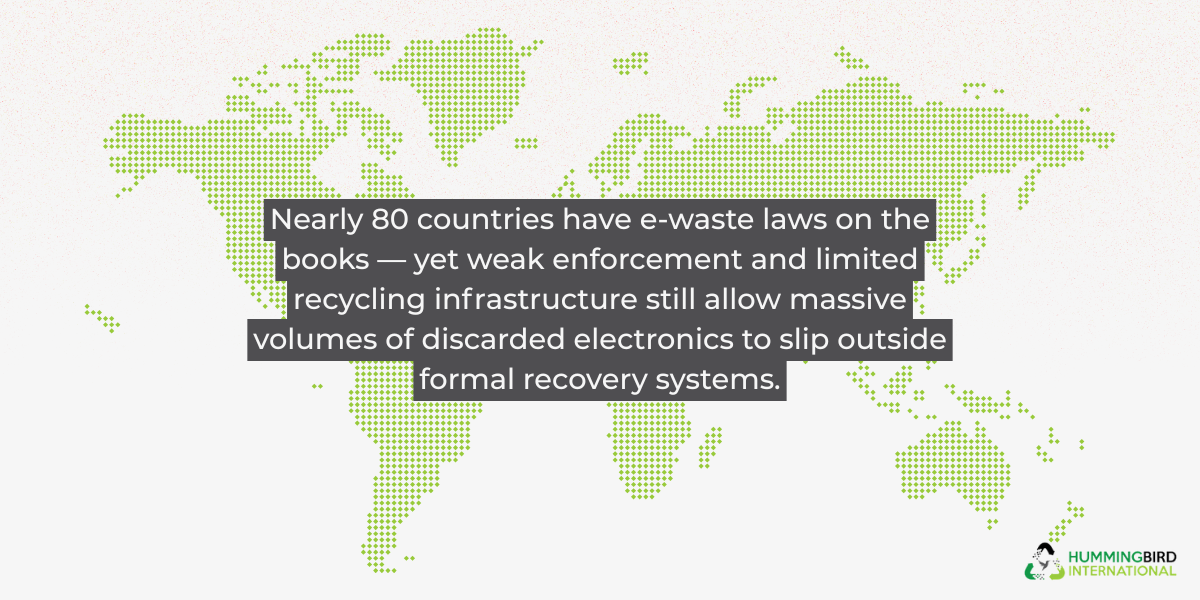
Electronic waste remains a pressing global challenge. The world now produces tens of millions of tonnes of e-waste each year, and only a fraction of this e-waste is formally recycled. Around 80 countries have some form of e-waste legislation, but many regions still lack strong enforcement or effective infrastructure, which means significant quantities of discarded electronics bypass formal recycling systems.
Key aspects of IT compliance include:
- Data protection and sanitization – Ensuring all sensitive information is securely erased long before equipment leaves your control.
- Environmental responsibility – Following regulations designed to prevent pollution and reduce hazardous exposure from discarded electronics.
- Documentation and traceability – Keeping clear records of how assets are handled, processed, and finalized so compliance can be verified during audits.
- Certification and standards adherence – Aligning with recognized frameworks that verify responsible practices and build credibility with customers and partners.
Together, these elements help businesses respond to a complex regulatory landscape while managing risk, strengthening security, and demonstrating ethical stewardship of technology assets.
Related Guides:
Old Devices: Responsible Tech Choices for 2026 and Beyond
Why Businesses Need to Rethink E-Waste Management
Why Compliance Matters for Businesses
Compliance in IT asset management and e-waste helps meet regulatory requirements. It directly affects how businesses manage risk, protect information, and maintain credibility. As technology lifecycles shorten and data volumes grow, the consequences of poor disposal or weak controls become more serious.
Clear ITAD regulations exist for a reason, and illegally disposing of them has consequences that extend well beyond simple fines. Strong compliance practices help organizations operate securely, avoid disruption, and demonstrate responsible stewardship of data and the environment.
-
Legal Risks

Image Source: iStock/deepblue4you
Failure to follow IT and e-waste regulations can lead to direct legal exposure. Laws governing data protection, hazardous waste handling, and electronic disposal impose clear obligations on businesses that generate or manage retired technology assets. Non-compliance can trigger investigations, penalties, and operational restrictions.
- Fines or enforcement actions for improper disposal of regulated electronic waste
- Liability under data protection laws if sensitive data is recovered from discarded devices
- Breach of contractual or regulatory obligations tied to certified disposal practices
- Exposure during audits or regulatory inspections due to missing documentation
When organizations cannot prove compliant handling of IT assets, legal risk extends beyond regulators to customers and partners who may pursue claims after a data or environmental incident.
-
Financial Risks

Image Source: iStock/Sezeryadigar
Non-compliance often results in costs that far exceed the expense of proper asset management and certified recycling. These costs may arise suddenly after an incident or accumulate over time due to ongoing inefficiencies and lost value.
- Regulatory fines and remediation costs after improper disposal or data exposure
- Expenses linked to breach response, notifications, and legal defence
- Loss of recoverable asset value when equipment is discarded without proper processing
- Higher insurance or compliance costs following violations or incidents
Beyond penalties, poor compliance can also disrupt operations if equipment tracking and retirement processes are unclear or inconsistent.
-
Reputational Risks

Image Source: iStock/JamesBrey
How a business handles retired technology increasingly reflects its broader governance and ethics. Stakeholders expect secure data handling and environmentally responsible disposal. Failures in either area can quickly erode trust.
- Public or client concern after reports of data leakage from discarded devices
- Brand damage linked to environmentally harmful disposal practices
- Loss of customer or partner confidence in data stewardship
- Negative scrutiny from investors or regulators regarding ESG performance
Reputation loss often persists long after financial or legal issues are resolved, affecting future contracts and partnerships.
Compliance Risk Overview
| Risk Area | What Can Go Wrong | Business Impact |
| Legal | Improper e-waste disposal or data exposure | Fines, investigations, legal liability |
| Financial | Breach response or lost asset value | Direct costs and operational loss |
| Reputational | Public or client trust erosion | Brand damage and lost opportunities |
Data Security and Environmental Responsibility
At the centre of compliance are two practical priorities: protecting information and preventing environmental harm. These are the core reasons IT asset disposal regulations exist and the consequences they have for both organizations and communities.
- Secure data sanitization prevents exposure of customer, employee, and corporate information
- Controlled recycling and disposal reduce the release of toxic materials into ecosystems
- Traceable asset handling ensures accountability across the device lifecycle
- Certified processing supports recovery of valuable materials and resource efficiency
By treating compliance as an operational discipline rather than a formality, businesses reduce risk across legal, financial, and reputational dimensions while supporting responsible technology lifecycle management.
Key IT Compliance Standards and Certifications
IT asset disposal regulations are supported by a mix of formal certifications, international standards, jurisdiction-specific, and state-specific e-waste laws. Together, they define how organizations should manage retired technology, protect data, and responsibly handle electronic waste. Understanding what each framework covers helps businesses choose certified ITAD partners, design internal processes, and demonstrate due diligence.
-
R2v3 (Responsible Recycling Standard)
R2v3 is one of the leading global certifications for electronics reuse and recycling. It sets strict requirements for how IT assets are collected, processed, sanitized, and tracked through their end-of-life stage. The standard places strong emphasis on data security, downstream accountability, and environmental controls.
Organizations working with R2v3-certified vendors gain assurance that retired equipment is handled under audited procedures. This includes verified data destruction methods, controlled material recovery, and documented tracking of components through the recycling chain. R2v3 also requires facilities to manage worker safety and environmental impact during processing.
-
ISO 14001 (Environmental Management Systems)
ISO 14001 is an international standard that guides how organizations manage environmental responsibilities across operations, including waste and resource use. While not limited to electronics, it plays a key role in IT asset disposal by requiring structured policies for waste handling, environmental risk reduction, and continuous improvement.
Businesses aligned with ISO 14001 establish formal procedures for identifying environmental impacts, setting reduction goals, and monitoring compliance. In IT asset contexts, this supports responsible recycling practices, pollution prevention, and documentation of disposal methods. It also signals to stakeholders that environmental performance is actively managed rather than reactive.
-
Data Protection and Privacy Regulations
Data protection laws govern how personal and sensitive information must be stored, transferred, and destroyed. These regulations apply directly to IT asset retirement because devices often contain recoverable data even after routine deletion. Proper sanitization or destruction is therefore a legal requirement, not simply a technical step.
Regulations such as the EU’s General Data Protection Regulation and similar national laws require organizations to ensure that personal data cannot be reconstructed once equipment leaves service. Failure to erase or destroy data securely can constitute a reportable breach. Compliance, therefore, requires verified erasure processes, documentation, and controlled custody of devices awaiting disposal.
-
National and State E-Waste Regulations
Many countries and regional authorities have specific laws governing the collection, transport, recycling, and export of electronic waste. These regulations often define which materials are hazardous, how they must be processed, what records must be maintained, and when devices must be reused over recycling. They also restrict landfill disposal of certain electronics and require the use of authorized recyclers.
For businesses, these rules determine how retired equipment must be handled within each jurisdiction. Requirements may include reporting e-waste volumes, using licensed facilities, or maintaining transfer documentation. Organizations operating across regions must align processes with the strictest applicable rules to remain compliant.
Comparison of Key IT Compliance Standards and Regulations
| Standard / Regulation | Primary Scope | Key Requirements | Why It Matters for IT Asset Disposal |
| R2v3 | Electronics recycling and reuse | Secure data destruction, downstream tracking, and environmental controls | Verifies responsible handling and certified recycling chain |
| ISO 14001 | Environmental management systems | Waste controls, impact monitoring, and documented procedures | Ensures structured and auditable disposal practices |
| Data protection laws | Personal and sensitive data | Secure erasure or destruction, breach prevention, and accountability | Prevents data exposure from retired devices |
| National or state e-waste laws | Electronic waste handling | Licensed recycling, restricted disposal, reporting | Defines legal disposal pathways and obligations |
Together, these standards and regulations form the foundation of compliant IT asset disposal. They address both sides of the risk landscape:
1. protection of information
2. protection of the environment
Businesses that align with recognized certifications and applicable laws not only meet regulatory requirements but also demonstrate measurable responsibility in the retirement and recycling of technology.
Also Read:
Sarbanes–Oxley Act (SOX) Favors Hard Drive Recycling
How R2v3 Ensures Secure Handling of Devices with Sensitive Data?
Practical Steps to Stay Compliant
Learning about IT asset disposal laws and regulations is only the first step. Compliance becomes meaningful when it is built into daily operations through clear policies, defined processes, and consistent oversight. Businesses that maintain retired technology responsibly treat disposal as a controlled lifecycle stage rather than an occasional task. This requires coordination across IT, security, procurement, and facilities functions.
A practical compliance framework ensures that every asset is tracked from active use to final disposition, with documented controls at each stage. It also confirms that data sanitization, storage, transport, and recycling are handled under approved procedures and verified partners.
1. Establishing Policies and Processes
Effective compliance starts with written policies that define how IT assets must be handled at the end of life. These policies should align with recognized standards and applicable regulations while remaining workable for internal teams. Clear ownership is essential so responsibilities do not fall between departments.
Key process areas typically include asset inventory management, retirement approval, data destruction methods, temporary storage controls, vendor selection, and documentation requirements. When these processes are standardized, businesses reduce the risk of informal disposal or undocumented transfers.
Implementation Checklist
- Maintain a complete and current inventory of all IT assets
- Define approved data sanitization or destruction methods by device type
- Require documented authorization before any asset leaves service
- Store retired equipment in secure, access-controlled areas
- Use only vetted and compliant recycling or ITAD vendors
- Keep transfer records and certificates of data destruction
- Track assets through collection, transport, and final processing
- Retain compliance documentation for audits and regulatory review
2. Monitoring and Internal Oversight
Compliance processes require regular monitoring to remain effective. Without oversight, gaps appear over time as equipment volumes grow or staff change. Periodic internal reviews help confirm that policies are followed in practice and that documentation remains complete.
Monitoring often includes reconciling asset inventories with disposal records, checking storage controls, and verifying that destruction certificates match retired equipment lists. Any discrepancies should trigger investigation and corrective action.
- Conduct periodic checks of retired asset inventories
- Verify documentation for each disposal or recycling event
- Review vendor performance and certification status
- Investigate missing or undocumented assets promptly
3. Audits and Verification
Formal audits provide structured assurance that IT asset disposal regulations and internal policies are being met. Audits may be internal or conducted by external assessors, especially when certifications or regulated data are involved.
Audit readiness depends on traceability. Businesses should be able to demonstrate where each asset went, how data was handled, and which vendor processed it. Well-maintained records and consistent procedures reduce audit disruption and strengthen compliance credibility.
- Schedule regular internal compliance audits
- Confirm traceability from inventory to final disposition
- Validate data destruction evidence and vendor certificates
- Document corrective actions and process improvements
4. Employee Training and Awareness
Even strong policies fail if employees are unaware of them or misunderstand their role. Staff involved in IT handling, storage, transport, or procurement must understand why controlled disposal matters and how to follow procedures. Training should be practical and role-specific rather than purely theoretical.
Awareness is especially important during office moves, equipment refresh cycles, or large-scale data decommissions, when the risk of informal disposal increases. Clear guidance helps prevent well-intended but non-compliant actions.
- Train relevant staff on approved disposal procedures
- Provide clear instructions for reporting retired equipment
- Reinforce data security responsibilities during device retirement
- Update training when regulations or processes change
When policies, monitoring, audits, and training work together, compliance becomes routine rather than reactive. Businesses gain confidence that IT assets are retired securely, regulations are met consistently, and disposal practices stand up to scrutiny.
Common Compliance Challenges and How to Overcome Them
Even with clear IT asset disposal regulations and defined processes, businesses often encounter practical barriers when managing retired technology. These challenges usually stem from scale, decentralized operations, or limited visibility into asset lifecycles. Recognizing common gaps helps organizations strengthen controls before they lead to compliance failures.
-
Limited Asset Visibility
Many organizations struggle to maintain an accurate, current inventory of IT assets across locations and departments. Devices may be reassigned, stored informally, or retired without record, thereby breaking traceability and increasing the risk of uncontrolled disposal.
How to address it
- Use centralized asset management systems with lifecycle tracking
- Reconcile inventories regularly against procurement and retirement records
- Require formal check-in of all decommissioned equipment
- Assign ownership for asset tracking at the department level
-
Inconsistent Data Destruction Practices
Without standardized sanitization methods, different teams may apply varying or inadequate data removal approaches. This creates exposure if devices leave custody with recoverable data.
How to address it
- Define approved sanitization methods by device category
- Use certified destruction or erasure tools and services
- Require verification and documentation for each device
- Prohibit disposal or resale without confirmed data removal
-
Unvetted or Non-Compliant Vendors
Selecting recycling or ITAD vendors based only on cost can lead to the use of partners that lack certification, downstream control, or proper environmental practices. Liability often remains with the asset owner.
How to address it
- Work with R2v3-certified and audited vendors
- Review certifications, audit reports, and process controls
- Require contractual compliance and reporting obligations
- Monitor vendor performance and certification status
-
Weak Documentation and Traceability
Incomplete records are a frequent compliance gap. If businesses cannot prove how assets were handled, regulators and auditors treat them as non-compliant even if the disposal was proper.
How to address it
- Maintain disposal records linked to asset IDs
- Retain certificates of destruction and transfer documents
- Store documentation in accessible compliance repositories
- Periodically audit record completeness and accuracy
-
Decentralized or Informal Disposal
In large or multi-site organizations, departments may dispose of equipment independently, bypassing approved processes. This leads to inconsistent handling and undocumented transfers.
How to address it
- Centralize disposal approval and coordination
- Provide clear procedures for all locations
- Train local staff on compliance requirements
- Monitor disposal activity across sites
Change-Solution Overview
| Common Challenge | Compliance Risk | Practical Solution |
| Poor asset visibility | Untracked or lost devices | Central lifecycle tracking and reconciliation |
| Inconsistent data erasure | Data exposure risk | Standardized sanitization methods |
| Non-compliant vendors | Legal and environmental liability | Certified vendor selection and oversight |
| Weak documentation | Audit failure | Linked disposal records and certificates |
| Decentralized disposal | Process bypass | Central approval and training |
Ending Note: Compliance Made Practical
Managing IT asset disposal properly is essential for protecting data, staying within the law, and handling e-waste responsibly. Following clear processes, using certified vendors, and keeping thorough records reduces legal, financial, and reputational risks. Regular audits and staff training ensure these practices are consistently applied across your business.
By taking compliance seriously, organizations not only avoid penalties but also demonstrate responsible management of technology, showing clients and partners that retired IT equipment is handled safely and securely throughout its lifecycle.
Dispose of Old Electronics Securely
Frequently Asked Questions
Curious about IT asset disposal and staying compliant? Here are the answers to the questions we hear most from businesses.
1. What is data sanitization in IT asset disposal?
Data sanitization in IT asset disposal is the process of permanently removing or destroying all data on a device before it is reused, recycled, or discarded. It ensures sensitive information cannot be recovered once equipment leaves organizational control. Simply deleting files or formatting is not enough, as data may still be restored.
Common methods include
- Secure data erasure with certified software
- Cryptographic erasure on encrypted drives
- Physical destruction of storage media
Proper sanitization is essential because businesses remain responsible for data risks even after devices are retired.
2. Are businesses legally responsible for data left on discarded devices?
Yes. Businesses remain legally responsible for any sensitive or personal data left on discarded or transferred devices. Data protection laws require organizations to ensure information is securely erased or destroyed before equipment leaves their control. If recoverable data is later exposed, the original owner may face regulatory penalties, breach notification obligations, and liability claims. Proper data sanitization and documented disposal are, therefore, essential to demonstrate compliance.
3. What certifications should an IT asset disposal vendor have?
A compliant IT asset disposal vendor should hold recognized certifications that verify secure data handling and responsible recycling. The most relevant include R2v3 for electronics recycling and downstream accountability, and ISO 14001 for environmental management.
Vendors handling sensitive data should also demonstrate audited data destruction processes and provide certificates of destruction and traceability records for all processed assets.
4. Do e-waste regulations vary by state or country?
Yes. E-waste regulations differ widely by country and often by state or region within a country. Laws may define which electronics are regulated, how they must be collected and recycled, and what documentation or reporting businesses must maintain. Some jurisdictions ban landfill disposal of certain devices or require the use of licensed recyclers.
Businesses operating across locations must follow the specific rules in each jurisdiction and often adopt the strictest standard across operations to ensure consistent compliance.
5. How often should IT asset disposal processes be audited?
IT asset disposal processes should be audited regularly, typically at least once a year, though higher-risk organizations may conduct audits more frequently. Audits ensure policies are followed, data is securely destroyed, and disposal complies with regulations and certifications.
Key aspects to review during audits:
- Asset inventory versus retired equipment
- Verification of data sanitization or destruction
- Vendor compliance and certificates
- Documentation and traceability for all disposed assets
Regular audits help identify gaps, enforce accountability, and maintain continuous compliance.


Leave a Reply