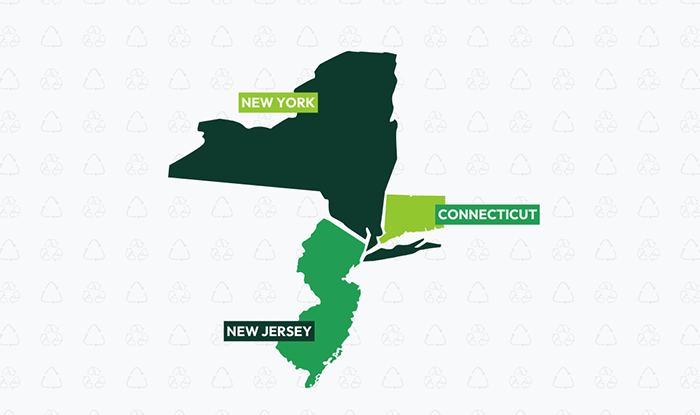
In many Tri-State offices, old IT equipment doesn’t disappear—it just gets moved around.
A batch of laptops from a recent upgrade ends up in storage. Decommissioned servers sit untouched because disposal isn’t urgent. Over time, what starts as a temporary decision turns into a buildup of unused assets.
In regions like New York, New Jersey, and Connecticut, where businesses operate at scale and under tight regulatory pressure, such a backlog can bring about real consequences. Retired devices can still hold sensitive data, and the cost of getting it wrong is high.
In case you didn’t know, the average data breach in the U.S. is estimated at around $9 million, with improperly handled IT assets often part of the risk. At the same time, those same devices aren’t worthless. When managed correctly, they represent recoverable value.
This is why IT asset liquidation is no longer treated as an afterthought. In the Tri-State area, it’s now essential for managing risk and ensuring compliance.
- Understanding IT Asset Liquidation
- Market Overview: What’s Driving ITAD Growth in the US
- Why the Tri-State Area Is a High-Value ITAD Market
- Regulatory Landscape in the Tri-State Area
- IT Asset Collection Across the Tri-State Region
- Market Trends Shaping IT Asset Liquidation
- Industry Landscape: Key Players and Operational Challenges
- Conclusion
- Frequently Asked Questions
- Why is IT asset liquidation important in the Tri-State area?
- What regulations affect IT asset liquidation in New York, New Jersey, and Connecticut?
- Why is chain-of-custody important in Tri-State IT asset liquidation?
- How do New York e-waste laws impact IT asset liquidation?
- What is the New Jersey E-Cycle program?
Understanding IT Asset Liquidation
IT asset liquidation is often misunderstood as simple disposal. In reality, it’s a structured process designed to securely retire IT equipment while recovering as much value as possible.
A typical IT asset disposition (ITAD) lifecycle includes four key stages:
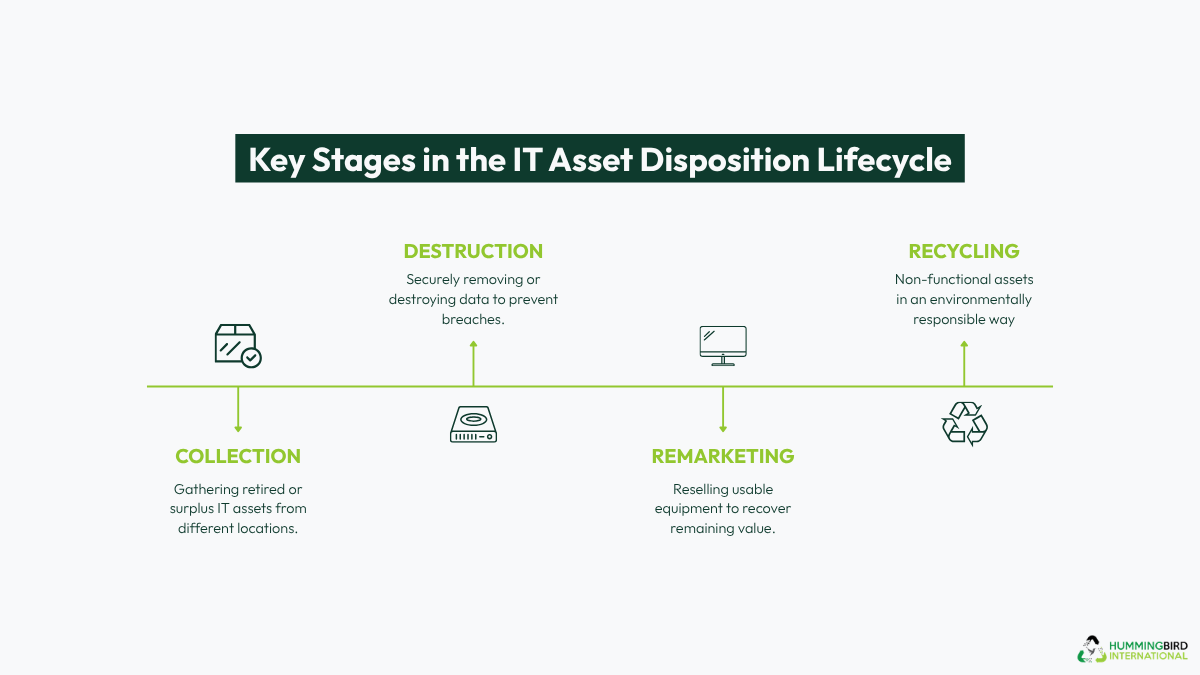
- Collection: Gathering retired or surplus IT assets from across locations
- Data Destruction: Securely wiping or destroying data to prevent breaches
- Remarketing: Reselling usable equipment to recover the residual value of IT equipment
- Recycling: Responsibly processing non-functional assets to meet environmental standards
Each step does more than remove old hardware. It helps ensure compliance and manage assets in a more controlled, accountable way. For organizations at scale, structure matters. The right ITAD partner can turn liquidation into controlled value recovery, not added risk.
Market Overview: What’s Driving ITAD Growth in the US
The IT asset disposition (ITAD) market is expanding steadily. The expansion is driven by faster technology cycles and a growing focus on sustainability. In the US, the ITAD market was valued at approximately $2.9 billion in 2023. It reflected the increasing demand for secure and compliant asset disposal.
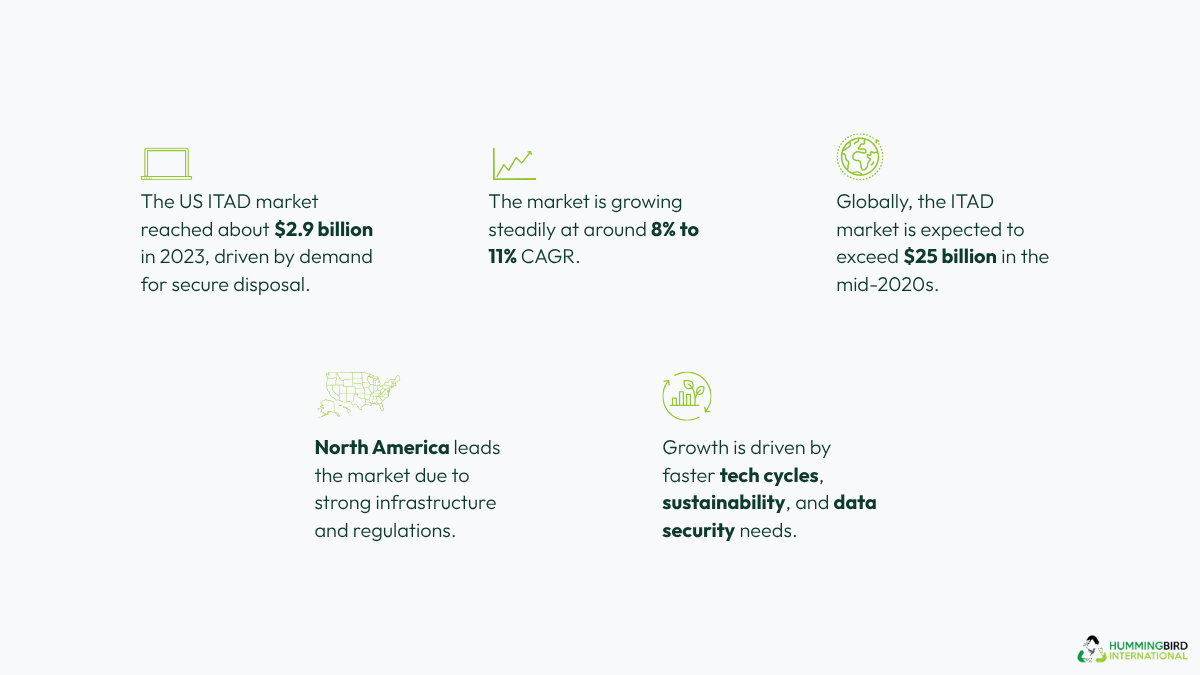
At a regional level, North America continues to lead growth. The market is projected to scale significantly over the next decade. According to Global Market Insights Inc., estimates suggest sustained growth rates ranging from ~8% to over 11% CAGR, depending on segment and forecast window.
Globally, the ITAD market is also on an upward trajectory, with projections placing it well beyond $25 billion in the mid-2020s. Several factors are driving this growth:
- Rising data security regulations: Stricter compliance requirements are pushing organizations toward certified disposal practices.
- ESG and sustainability mandates: Companies are under pressure to reduce e-waste and support circular economy models.
- Cloud adoption: Faster refresh cycles are increasing the volume of decommissioned assets.
- Circular economy adoption: Refurbishment and resale are becoming standard, not optional.
The change is quite apparent. IT asset liquidation is no longer being seen as a cost center. Instead, people are starting to see it more and more as a role that helps with both compliance and measurable value recovery.
Why the Tri-State Area Is a High-Value ITAD Market
The Tri-State area, consisting of New York, New Jersey, and Connecticut, is one of the most important IT asset markets in the US. This is driven by industry density and high asset turnover.
| Factor | Tri-State Example | Impact |
| Finance | JPMorgan Chase, Goldman Sachs | Frequent upgrades → steady asset flow |
| Healthcare | Mount Sinai Health System, Hackensack Meridian Health | Strict data handling → compliance-driven ITAD |
| Corporates | IBM, Verizon | Large IT estates → ongoing liquidation needs |
| Regulation | Strong state-level data & e-waste laws | Drives certified vendor demand |
| Volume | NYC metro concentration | High, consistent asset turnover |
Since there are so many businesses and operations in major metro regions like New York, they have the most ITAD demand. Thus, the Tri-State is not just dynamic; it is also one of the most compliance-focused ITAD ecosystems in the US.
Regulatory Landscape in the Tri-State Area
In the Tri-State region, IT asset liquidation is shaped by layers of data security, industry-specific, and environmental regulations. Keep in mind, compliance isn’t optional, as it directly influences how organizations handle retired IT assets.
Have a look at this table that condenses the information:
| Category | Regulation / Standard | What It Requires | Impact on ITAD |
| Data Security | NIST Special Publication 800-88 | Secure, verifiable data destruction | Standardizes wiping & destruction processes |
| General Data Protection Regulation (GDPR) | Protection of EU personal data | Affects global firms operating in the Tri-State | |
| CCPA-like expectations | Stronger data privacy practices | Pushes stricter internal policies | |
| Finance | Sarbanes-Oxley Act (SOX) | Accurate recordkeeping, data integrity | Requires controlled asset handling |
| Gramm–Leach–Bliley Act | Protection of financial data | Increases the need for secure disposal | |
| Healthcare | Health Insurance Portability and Accountability Act (HIPAA) | Safeguarding patient data | Strict data destruction requirements |
| Environmental | State e-waste laws (e.g., New York, New Jersey) | Responsible disposal of electronics | Limits landfill, enforces recycling |
| Zero-landfill initiatives | Sustainable waste management | Encourages recycling & reuse | |
| Certifications | R2 Certification | Responsible recycling practices | Validates environmental compliance |
| NAID AAA Certification | Secure data destruction processes | Builds trust & audit readiness |
Hummingbird International aligns with these expectations through R2v3 certification and ISO standards. It supports secure handling and responsible recycling practices at every stage of IT asset liquidation.
IT Asset Collection Across the Tri-State Region
Handling IT asset pickup across the Tri-State isn’t as straightforward as it sounds. What works in one state doesn’t always apply in another.
• New York
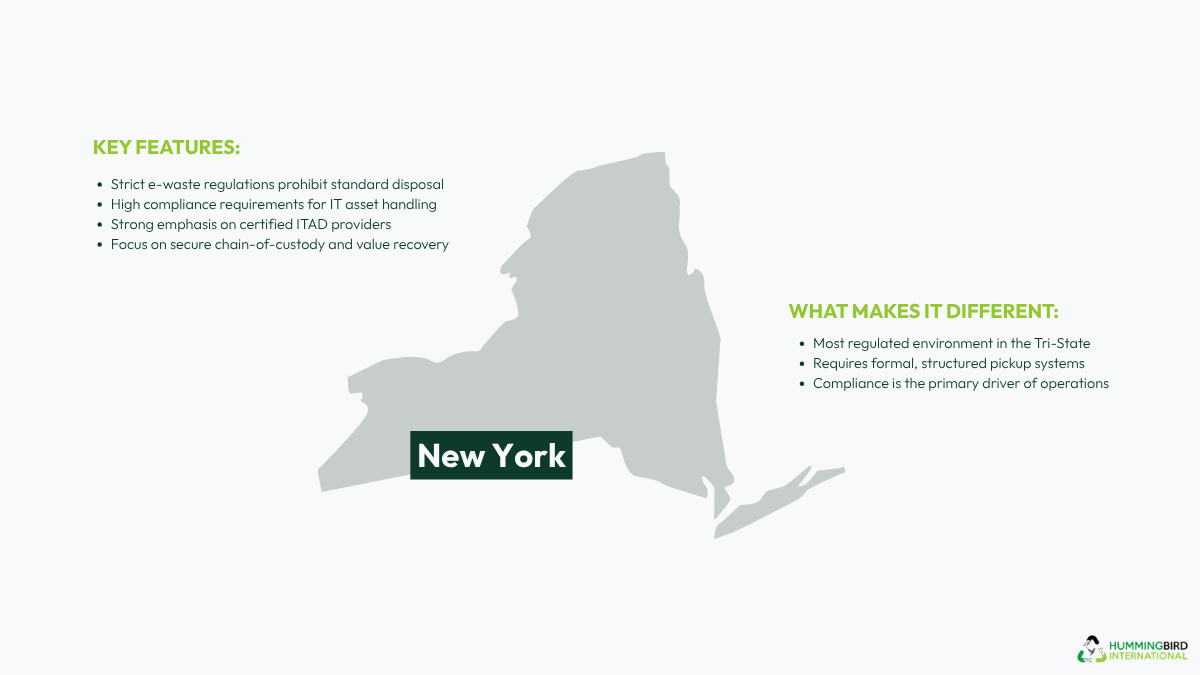
ITAD in New York is governed by strict e-waste regulations that prohibit businesses from disposing of electronics through standard waste streams. As a result, structured pickup services are essential for compliant and responsible IT asset management.
Partnering with certified ITAD providers ensures that assets are securely managed from the moment they leave the premises. They also facilitate responsible recycling and maximize value recovery.
• New Jersey
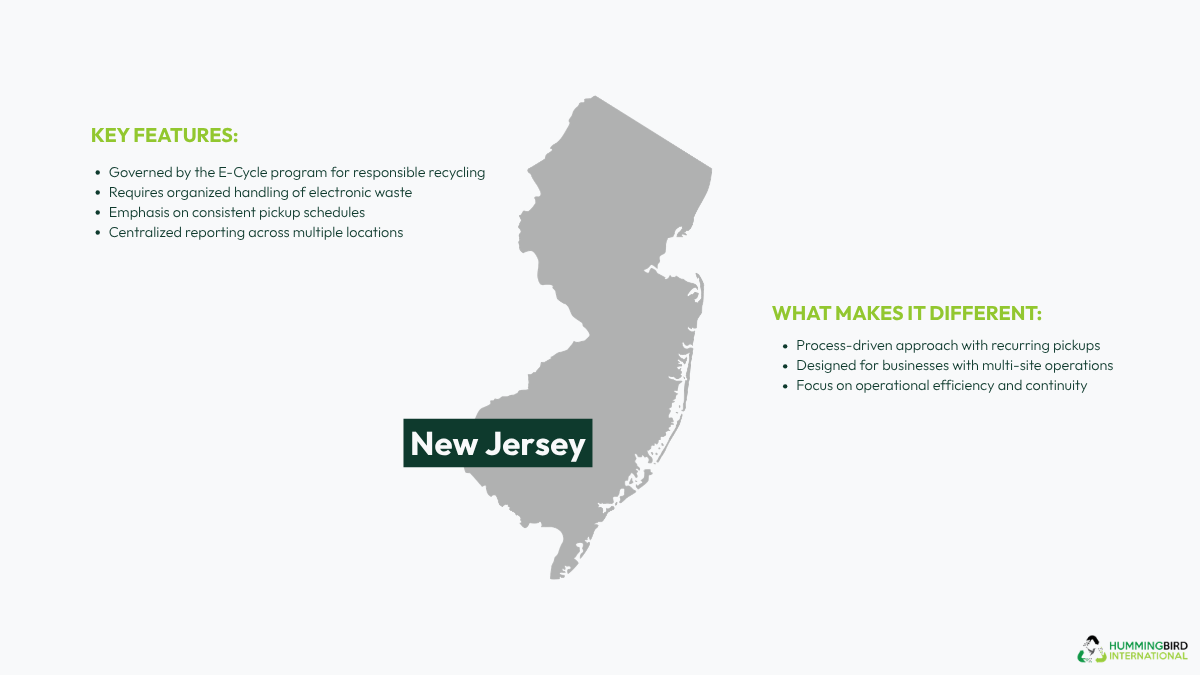
The New Jersey E-Cycle program, which requires responsible recycling of electronic devices, is one of the programs that affects ITAD and e-waste pickup in New Jersey.
To stay compliant, organizations with multiple sites need consistent pickup schedules and centralized reporting. A well-run pickup process keeps storage from piling up and makes sure that assets move through their life cycle without any delays.
• Connecticut
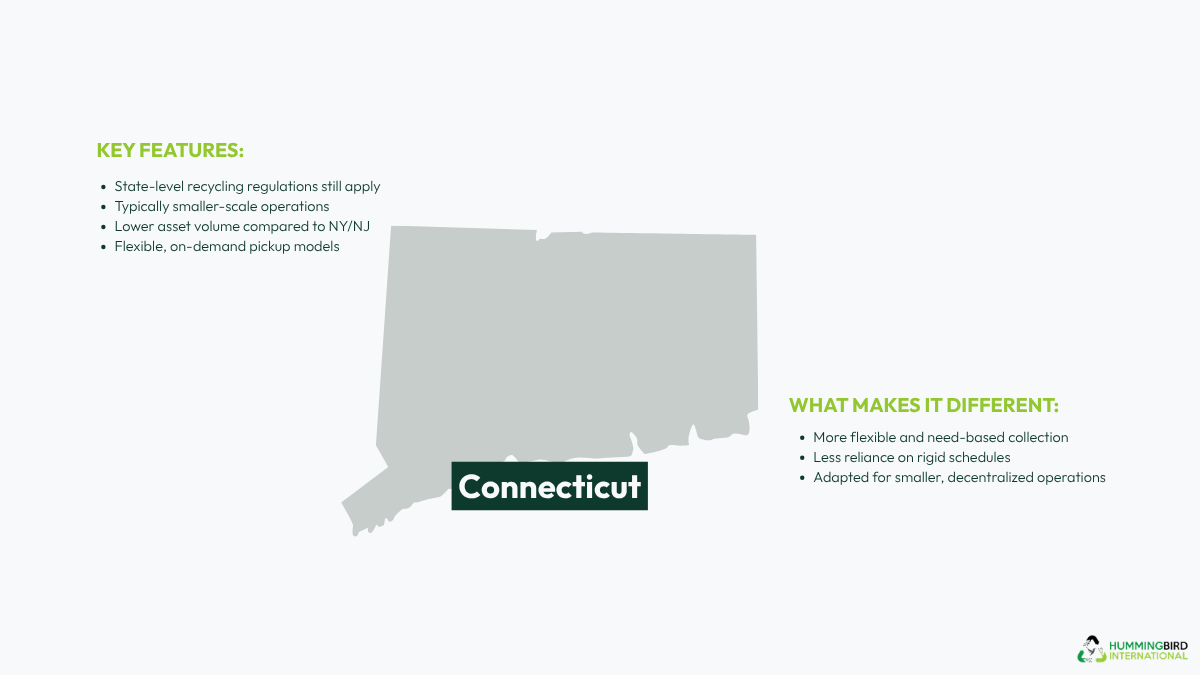
State-level recycling regulations influence ITAD in Connecticut, but the operational scale is often distinct from larger Tri-State markets. Many businesses oversee fewer locations and smaller asset volumes.
This changes the process of pickup. Businesses frequently use more flexible, need-based collection in place of lengthy, planned cycles while still maintaining compliance and proper documentation.
Market Trends Shaping IT Asset Liquidation
The way organizations handle retired IT assets is changing. The focus has shifted toward what can be retained, reused, and accounted for.
1. Shift Toward Value Recovery
IT asset liquidation is about recovering measurable value. Remarketing has emerged as one of the fastest-growing segments, with estimates placing its growth at around ~15% CAGR.
Companies in the Tri-State are starting to see old IT equipment as money instead of trash. When correctly graded and sold again, laptops, servers, and networking equipment can get back some of the money you spent on them.
2. Data Destruction Dominance
Despite the focus on value recovery, data destruction remains the largest segment, accounting for roughly ~38% of ITAD services. The reason is simple: risk outweighs resale value if data is not handled properly. As a result, organizations often prioritize certified data sanitization before any remarketing decision is made.
3. Rise of the Circular Economy
The ITAD industry is aligning with circular economy principles: refurbish, resell, and reuse wherever possible before recycling. This approach reduces e-waste while extending the lifecycle of IT equipment. Many organizations now track sustainability KPIs, including landfill diversion rates and carbon impact.
4. OEM Take-Back Programs
Original Equipment Manufacturers (OEMs) are increasingly integrating ITAD into their product lifecycle. Companies like Dell Technologies and Hewlett Packard Enterprise offer take-back and recycling programs as part of their enterprise solutions. So, these programs simplify asset return and ensure responsible handling.
Industry Landscape: Key Players and Operational Challenges
The Tri-State Area brings together large-scale operations and complex IT asset workflows.
Major players such as Iron Mountain and Arrow Electronics continue to expand their ITAD capabilities to meet growing enterprise demand. For example, Sims Recycling Solutions expanded its IT asset disposition facility in 2023 because of its increased volumes and stricter compliance requirements across industries.
At the same time, businesses in the Tri-State region face persistent operational challenges:
- Vendor selection complexity: Not all providers offer the same level of certification or transparency
- Compliance risk: Regulatory requirements leave little room for error
- Limited chain-of-custody visibility: Gaps in tracking increase audit and security risks
- Storage backlogs: Retired assets often accumulate due to delayed disposal decisions
- Cost inefficiencies: Delayed pickups and low-volume batches often increase per-asset handling costs
Improper IT asset liquidation is rarely a technical failure; it’s usually a process gap, something explored further in common myths about IT asset disposal. Addressing these challenges often comes down to having a more structured approach.
Working with an experienced ITAD provider like Hummingbird International can help streamline IT asset liquidation with structured processes, secure handling, and better visibility across the entire lifecycle.
Conclusion
Clearing out retired IT equipment used to be a routine task. Today, it’s closely tied to data security and value recovery. In regions like the Tri-State, where compliance requirements are tighter and operations run at scale, how these assets are handled carries real consequences.
Organizations that approach ITAD as a defined, ongoing process tend to see better outcomes. It helps recover more value from what they already own and keep up with sustainability expectations.
At this stage, most organizations already know liquidation is necessary—the real difference lies in how well the process is handled, and Hummingbird International can make that difference measurable.
Frequently Asked Questions
Why is IT asset liquidation important in the Tri-State area?
IT asset liquidation, also known as IT Asset Disposition (ITAD), plays a key role in the Tri-State area (NY, NJ, CT). The region’s concentration of finance, healthcare, and enterprise firms, combined with strict regulations and frequent tech upgrades, makes structured, compliant asset management essential.
What regulations affect IT asset liquidation in New York, New Jersey, and Connecticut?
IT asset liquidation in New York, New Jersey, and Connecticut is shaped by strict data destruction laws and e-waste regulations. Businesses must ensure secure data handling, follow standards like NIST SP 800-88, and comply with state-specific recycling laws to avoid penalties and maintain audit readiness.
Why is chain-of-custody important in Tri-State IT asset liquidation?
Chain-of-custody is essential in Tri-State IT asset liquidation because it creates a clear, verifiable trail from pickup to final disposition. This visibility helps organizations meet audit requirements, maintain accountability, and reduce the risk of data exposure during handling, transport, and processing stages.
How do New York e-waste laws impact IT asset liquidation?
New York e-waste laws, including the NYS Electronic Equipment Recycling and Reuse Act, prohibit landfill disposal of electronics. Businesses must use certified ITAD vendors for compliant recycling and data destruction, while the Digital Fair Repair Act supports repair, refurbishment, and resale to improve ROI.
What is the New Jersey E-Cycle program?
The New Jersey E-Cycle program, based on the Electronic Waste Management Act, mandates proper recycling of electronics like computers and monitors. It prohibits curbside disposal and requires manufacturers to fund and manage environmentally safe recycling for consumers and small businesses.