Decommissioning a hyperscale data center isn’t just a shutdown—it’s a high-stakes operational exercise where even small errors can have large-scale consequences.
Hyperscale data centers are designed for scale, but that same scale makes decommissioning far more complex than a typical shutdown. It’s not just about turning systems off—it’s about carefully unwinding a deeply interconnected environment.
At this level, a single hyperscale facility can house 5,000+ servers, span millions of square feet, and consume massive amounts of power. With systems tightly linked across compute, storage, and networks, even a minor misstep can lead to service disruption, data exposure, or compliance risks.
Shutting down an environment like this isn’t a one-time event. It’s a structured, multi-phase process involving planning, secure data management, controlled execution, and strict oversight at every stage.
This blog breaks down the key technical phases involved—and what it takes to execute them effectively.
- Why Hyperscale Decommissioning Requires a Technical Approach?
- Breaking Down the Phases of Hyperscale Data Center Decommissioning
- Phase 1: Strategic Planning and Assessment
- Phase 2: Asset Discovery and Dependency Mapping
- Phase 3: Data Backup, Migration, and Validation
- Phase 4: Secure Data Sanitization and Destruction
- Phase 5: De-Installation and Physical Removal
- Phase 6: Logistics, Transportation, and IT Asset Disposition (ITAD)
- Phase 7: Asset Recovery, Remarketing, and Recycling
- Phase 8: Site Decommissioning and Restoration
- Phase 9: Documentation, Compliance, and Reporting
- Key Challenges in Hyperscale Decommissioning
- Conclusion
- FAQs
Why Hyperscale Decommissioning Requires a Technical Approach?
With hyperscale decommissioning, the challenge is not only magnitude but also density, interconnectedness, and the reality that operations frequently continue during the transition. Hyperscale facilities can handle massive amounts of data, with workloads distributed over clusters, regions, and redundant systems.
While this architecture increases resilience, it also complicates decommissioning. Systems cannot simply be turned off without first determining what else depends on them.
At the same time, the scale is only increasing.
The hyperscale market is projected to reach $358 billion by 2034, meaning more facilities will eventually face upgrades or shutdown.
On the ground, this complexity is tangible. Individual sites can consume 50MW+ power, supported by layered cooling systems and high-density infrastructure.
In one hyperscale decommissioning project, tens of thousands of assets had to be tracked and removed in stages—simply to avoid disrupting active workloads running in parallel.
Breaking Down the Phases of Hyperscale Data Center Decommissioning
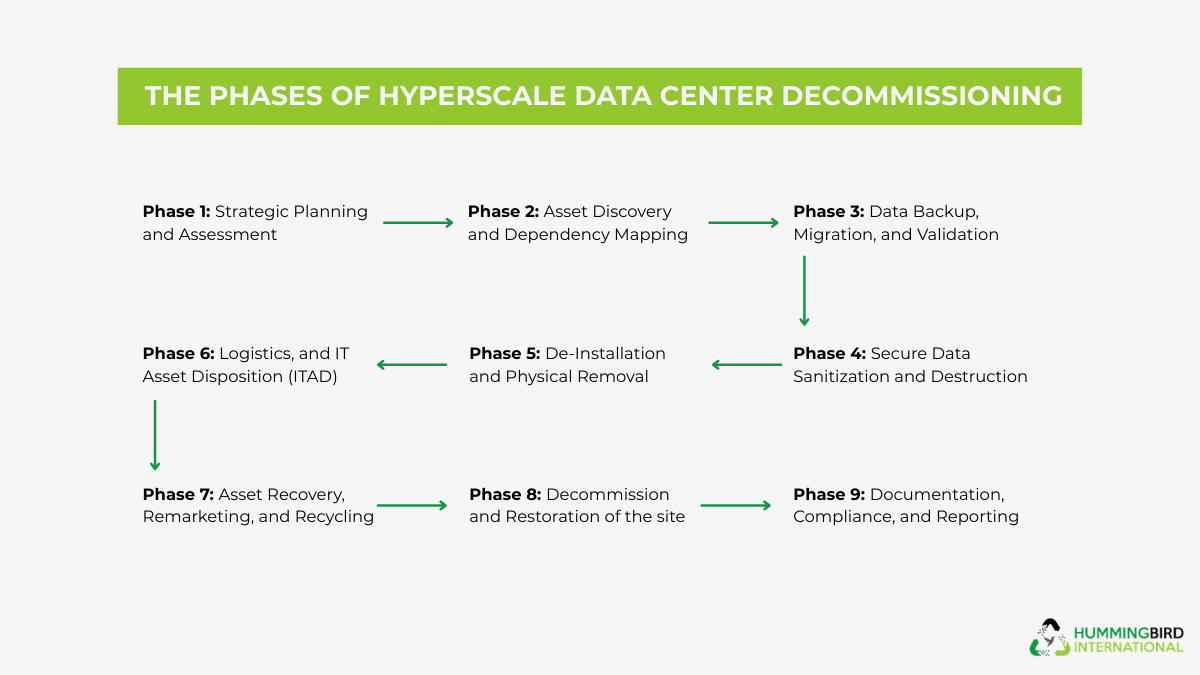
Hyperscale data center decommissioning is typically executed in structured phases to ensure operational continuity, compliance, and risk mitigation. Rather than a single linear process, it involves coordinated stages that address planning, asset visibility, data protection, and physical removal.
Each phase builds on the previous one, requiring precision and cross-functional collaboration to prevent disruptions in active environments. At this scale, even minor oversights can cascade into significant operational or compliance risks, making a phased approach essential for success.
Phase 1: Strategic Planning and Assessment
At hyperscale, planning isn’t a checklist; it’s a full-scale audit of a highly distributed environment. Typically, the following things have to be taken care of before kicking off the decommissioning:
- Inventory thousands (or even tens of thousands) of assets across zones, racks, and systems
- Define compliance requirements across regions, including data protection and environmental regulations
- Align stakeholders across IT, operations, logistics, and compliance teams
- Establish timelines, risk frameworks, and decommissioning workflows
In practice, this step frequently reveals underlying complexity. Detailed audits frequently reveal legacy systems, undocumented assets, and redundant infrastructure. According to industry experts, incomplete asset inventories are one of the leading reasons of delays and compliance concerns in decommissioning operations.
At hyperscale, getting this step right is critical. Any gaps here do not remain isolated; they compound across every stage that follows.
Phase 2: Asset Discovery and Dependency Mapping
When it comes to thousands of servers and deeply interconnected systems, understanding dependencies is essential before any shutdown can begin.
Hyperscale environments are designed for resilience:
- Workloads are distributed across clusters
- Storage is replicated across multiple nodes
- Systems automatically fail over to maintain uptime
Although this increases availability, it complicates decommissioning. Industry guidance repeatedly emphasizes dependency mapping as a vital step, as shutting down shared infrastructure without full visibility might result in unforeseen service outages.
This isn’t just theoretical. Incidents like the 2017 Amazon Web Services outage have shown how tightly coupled systems can amplify even small operational errors.
Phase 3: Data Backup, Migration, and Validation
Before any infrastructure is touched, data needs to be secured, moved and confirmed. At hyperscale, this includes:
- Migrating large volumes of data across environments
- Ensuring redundancy across distributed storage systems
- Running multiple validation checks to confirm data integrity
Data volumes in hyperscale environments can approach petabytes, making migration a serious operational effort rather than a background task. Organizations often run parallel systems during relocation to ensure continuity.
Phase 4: Secure Data Sanitization and Destruction
This is the most sensitive phase, where data security risks are highest. Hyperscale facilities can contain tens of thousands of storage devices, each requiring certified processes such as hard drive disposal through software wiping, degaussing, or physical destruction.
In an SK Tes case study for a hyperscale decommissioning project, the following observations were taken into account:
- 72,000 storage drives require sanitization
- 96% were wiped onsite, minimizing handling risks
- Full chain-of-custody ensured audit compliance
This scale renders manual handling pretty much useless. Automated workflows and strict documentation are essential to ensure no recoverable data leaves the facility.
Phase 5: De-Installation and Physical Removal
Once data is secured, physical de-installation begins—but even this phase requires precision.
At hyperscale:
- Equipment removal is executed in phases or parallel streams
- Systems are powered down in controlled sequences
- Every asset is labeled, tracked, and documented
In large facilities, thousands of components, from servers to networking gear, must be removed without disrupting any remaining active systems. In practice, this phase resembles a coordinated engineering operation. Mislabeling or improper sequencing can lead to delays or operational risks, especially in environments where partial workloads are still active.
Phase 6: Logistics, Transportation, and IT Asset Disposition (ITAD)
After removal, assets enter a logistics chain that must be tightly controlled.
At hyperscale:
- Thousands of assets are packed, transported, and tracked
- Secure logistics ensure no data exposure during transit
- Certified ITAD vendors handle downstream processing
Organizations rely on a certified ITAD partner to ensure secure handling, compliance, and asset tracking. According to our research, industry reports highlight that poor asset tracking during transit is a common failure point, leading to lost equipment or compliance gaps.
In real-world scenarios, logistics at this stage often mirror supply chain operations, requiring coordination, tracking systems, and secure handling protocols across multiple locations.
Phase 7: Asset Recovery, Remarketing, and Recycling
Decommissioning isn’t just about disposal—it’s also an opportunity to recover value. Many hyperscale environments retire hardware that still has significant resale potential. Structured ITAD strategies allow organizations to:
- Remarket usable equipment
- Redeploy assets internally
- Recycle obsolete hardware responsibly
In the same hyperscale project:
- Asset remarketing generated $4.9 million in resale value
- Financial returns improved by 34% (SK Tes case study)
Most organizations tend to recover value by effectively monetizing retired IT assets through structured remarketing strategies. This demonstrates that with the right approach, decommissioning can offset costs and even generate measurable returns.
Phase 8: Site Decommissioning and Restoration
Once equipment is removed, attention shifts to the facility itself. Hyperscale data centers often span millions of square feet and include complex infrastructure such as advanced cooling systems, power distribution units, and cabling networks.
This phase involves:
- Removing supporting infrastructure
- Ensuring environmentally responsible disposal
- Preparing the site for reuse or lease handover
Ensuring environmentally responsible enterprise e-waste recycling during infrastructure removal can help in the long run. Given the size and complexity, restoration can become a standalone project. For leased facilities, incomplete restoration can lead to contractual penalties or delays.
Phase 9: Documentation, Compliance, and Reporting
The final phase ensures that every step of the process is documented and verifiable. Teams compile:
- Data destruction certificates
- Asset tracking and audit logs
- Compliance and environmental reports
With increasing regulatory oversight, particularly around data privacy and e-waste, documentation is critical. It provides proof that assets were handled securely and in accordance with legal and environmental standards.
Maintaining detailed records positions organizations better for audits and future decommissioning projects.
Key Challenges in Hyperscale Decommissioning

Photo Credit: iStockPhoto/tiero
Hyperscale environments introduce a level of complexity that goes far beyond traditional data center decommissioning.
- Massive infrastructure scale – Large facilities can span millions of square feet, with teams coordinating removal across multiple zones simultaneously to avoid overlap and delays.
- Extreme power dependency – Some hyperscale sites draw enough electricity to support tens of thousands of households, requiring carefully sequenced shutdowns.
- Cooling system complexity – Advanced cooling setups, including liquid cooling, demand controlled deactivation to avoid overheating or equipment damage.
- Distributed data architecture – Hyperscale environments often operate at petabyte scale, where data exists across multiple regions—making full validation a multi-step process rather than a single check.
- Hidden system dependencies – Interlinked systems mean even minor oversights can trigger unintended service disruptions.
- Parallel live operations – Decommissioning often runs alongside active workloads, increasing coordination and risk management requirements.
- Large-scale asset handling – In real-world projects, tens of thousands of components are tracked individually, often using asset management systems to maintain visibility from rack to resale.
- Regulatory and audit pressure – Many decommissioning projects now require full audit trails and destruction certificates, especially when handling enterprise or customer-sensitive data.
- Sustainability expectations – With global e-waste exceeding 50 million metric tons annually, addressing growing e-waste challenges has become a critical part of responsible hyperscale decommissioning.
- Legacy system complexity – Older or undocumented infrastructure can slow down execution and introduce unexpected dependencies.
- Value recovery challenges – Without structured processes, organizations risk underutilizing high-value hardware during decommissioning.
Conclusion
Decommissioning a hyperscale data center is an organized, multi-phase process requiring precision in planning, data protection, execution, and compliance. Given the size and interconnectivity of these environments, even minor oversights can pose serious dangers.
With the appropriate methodology, enterprises may not only ensure a secure transition but also recover value and satisfy sustainability objectives. As a result, decommissioning is transformed into a strategic component of the data center lifespan.
FAQs
What are the steps in the decommissioning process?
The decommissioning process starts with notifying authorities that operations have stopped. A decommissioning plan is then submitted and approved. After approval, the plan is carried out, including dismantling and cleanup. Finally, inspections and documentation confirm everything has been completed properly and meets all regulatory requirements.
What are the big 5 hyperscalers?
The five major hyperscale providers are Amazon Web Services (AWS), Google Cloud, Microsoft Azure, IBM Cloud, and Oracle Cloud. Together, they deliver a wide range of services, including computing power, storage, AI/ML capabilities, and advanced security solutions.
What are the challenges of hyperscale data centers?
Hyperscale data centers often face delays due to power limitations, regulatory hurdles, supply chain disruptions, and labor shortages. However, with proactive planning, these challenges can be managed, making workforce readiness a key factor in keeping projects on track.
What is the future of hyperscale data?
The hyperscale data center market is rapidly expanding, becoming a core pillar of the global digital economy. It is projected to grow from USD 160.55 billion in 2025 to USD 579.98 billion by 2032, reflecting a strong CAGR of 20.13%.
How quickly do data centers become obsolete?
Like most commercial buildings, the core structure can last well beyond 20 years. However, the internal systems, such as IT equipment, power infrastructure, and cooling systems. Typically have a lifespan of 10–20 years before becoming outdated or inefficient.


Leave a Reply