
- What Is the Importance of E-Waste Recycling for Enterprises?
- What is Enterprise E-Waste?
- Recycling vs ITAD vs Asset Liquidation
- Data Security and Compliance Are Non-Negotiable
- Enterprise and Multi-Location E-Waste Operations
- Specialized Business Scenarios
- ESG, Sustainability, and Circular Economy Impact
- How to Choose the Right E-Waste Recycling Partner
- Start Secure, Compliant E-Waste Recycling Today
- Frequently Asked Questions
What Is the Importance of E-Waste Recycling for Enterprises?
E-waste recycling for businesses is the structured and compliant process of retiring electronic assets without exposing the organization to data, legal, or reputational risk. As companies refresh devices more frequently, unmanaged electronics quickly become liabilities rather than leftovers.
The scale of the issue is growing fast. Globally, 62 million metric tonnes of e-waste were generated in 2022, yet only 22 percent was properly recycled, leaving massive gaps in security, compliance, and environmental control.
For businesses, the importance goes beyond sustainability. Poor e-waste practices can lead to data breaches, regulatory penalties, lost asset value, and failed audits. A structured recycling and ITAD approach helps organizations stay compliant, protect sensitive information, and document responsible handling across their entire IT lifecycle.
Unlike residential recycling, enterprise e-waste involves:
- Chain-of-custody tracking: A documented trail that shows where assets go and who handles them, from collection through final disposition.
- Certified data destruction: Verified methods to permanently eliminate data from devices, reducing exposure to breaches and compliance violations.
- Regulatory documentation: Records that demonstrate compliance with environmental, privacy, and industry-specific regulations.
- Multi-location logistics: Coordinated collection and transport of assets across offices, facilities, or regions without breaking security controls.
ESG and audit reporting: Clear reporting that supports sustainability goals, internal audits, and external stakeholder expectations.
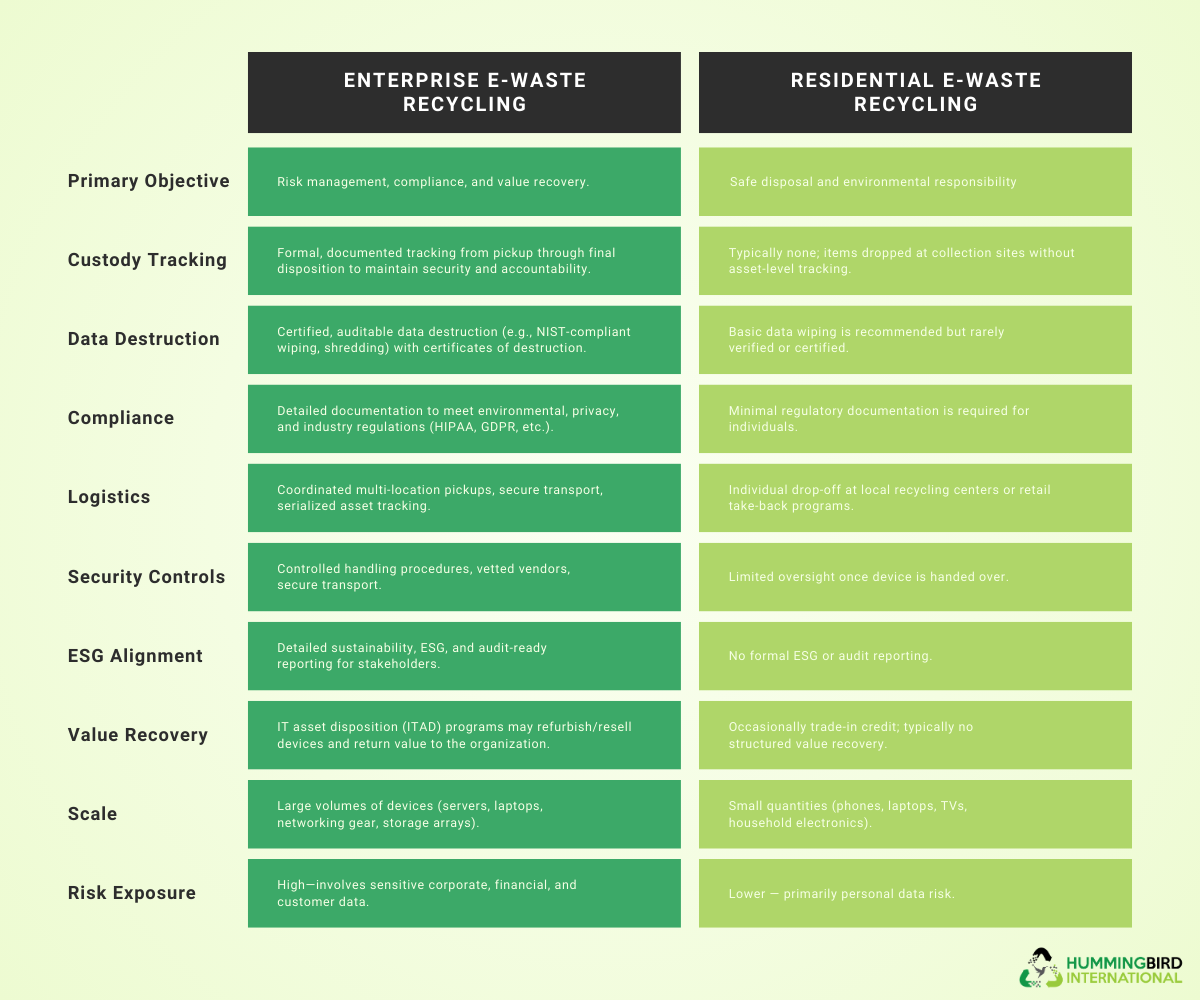
This structured approach turns e-waste recycling into a risk-management and value-recovery strategy, not just a disposal task.
Related Deep Dives:
What We Learned About E-Waste in 2025?
15 Facts About Recycling (What Most People Don’t Know But Should)
What is Enterprise E-Waste?
Most organizations underestimate how wide their e-waste footprint really is. Business e-waste is not limited to old laptops in storage closets. It includes any electronic asset that has reached the end of its useful life, whether it holds data, connects to a network, or supports daily operations. Each category carries different security, compliance, and recovery considerations.
Common enterprise e-waste categories include:
-
Laptops and desktops
End-user devices often contain sensitive business and customer data, even after years of use. Follow a proper laptop recycling guide to ensure certified data destruction, compliant disposal, and potential resale or material recovery based on device condition.
-
Servers and networking gear
Servers, switches, routers, and firewalls sit at the core of business infrastructure. Data center decommissioning requires a strict chain of custody, secure data erasure, and coordinated removal to avoid downtime, data exposure, or compliance failures.
-
Hard drives and storage media
Hard drives, SSDs, tapes, and removable media pose the highest data risk if mishandled. Secure hard drive disposal focuses on verified destruction methods that permanently eliminate data while meeting regulatory and audit requirements.
-
Monitors and LCDs
Displays may not store data, but they contain hazardous materials and recoverable components. LCD monitor recycling benefits include safe handling of toxic elements and responsible material recovery that supports environmental compliance.
-
Mixed electronics and peripherals
Keyboards, phones, printers, scanners, cables, and accessories often accumulate unnoticed. Other electronic waste still requires compliant disposal processes to prevent environmental harm and to maintain consistent ESG and audit reporting.
Why this matters
Each enterprise e-waste category demands a different disposal and security pathway. Choosing the wrong approach increases exposure to data loss, regulatory penalties, and missed recovery value. A category-specific strategy ensures risk is controlled while maximizing responsible reuse and recycling outcomes.
Recycling vs ITAD vs Asset Liquidation
Not all retired electronics should be handled the same way. The right path depends on whether an asset still holds data, market value, or neither. Businesses often use a mix of these approaches, with a qualified e-waste or ITAD partner helping determine the correct route for each asset type.
| Path | When It Applies | What the Service Covers |
| Recycling | End-of-life assets with no resale value |
Recycling ensures environmentally compliant processing, safe handling of hazardous materials, and documented commercial disposal |
| IT Asset Disposition (ITAD) | Devices that contain data or may have residual value |
ITAD services cover secure data destruction, chain of custody tracking, compliance reporting, and controlled reuse or recycling |
| Asset Liquidation | Equipment suitable for resale or reuse |
Asset liquidation includes data sanitization, testing, refurbishment, and resale to recover maximum residual value |
In practice, most organizations use a combination of all three. A structured e-waste and ITAD strategy ensures each asset is routed through the pathway that best aligns with its risk profile and recovery potential.
Also Read:
Economic Benefits of E-Waste Recycling
Data Security and Compliance Are Non-Negotiable
When devices are no longer actively used, they do not stop being a data risk. Laptops, servers, hard drives, and even removable media often retain sensitive information long after systems are decommissioned. If those assets are mishandled, businesses expose themselves to data breaches, regulatory penalties, legal claims, and reputational damage. That risk only grows at scale, especially across multiple locations or during large refresh cycles.
For this reason, data security must sit at the center of any e-waste recycling or ITAD program. Informal disposal methods, incomplete wiping, or undocumented handling are not acceptable for business environments. Secure outcomes depend on clear controls, verified processes, and defensible records that hold up under audit.
Required controls for businesses include:
- Certified data wiping (NIST 800-88): Logical data erasure must follow recognized standards such as NIST 800-88 to ensure data is permanently removed and unrecoverable. Certified wiping supports compliance while allowing eligible devices to be reused or resold safely.
- Physical destruction for failed drives: When drives cannot be wiped or verified, physical destruction becomes mandatory. Secure hard drive destruction eliminates residual data risks by rendering storage media permanently unusable.
- Tamper-proof chain of custody: Assets must be tracked from the point of collection through final disposition. A secure chain of custody reduces exposure during transport, storage, and processing while providing accountability at every stage.
- Audit-ready reporting: Detailed documentation is essential for regulatory reviews, internal audits, and client assurance. Reports should clearly show how assets were handled, how data was destroyed, and which standards were applied.
To meet these requirements, businesses rely on specialized services rather than general recycling.
- Data destruction services address secure wiping and certified destruction across IT assets.
- Hard drive destruction focuses on high-risk storage media that demand verified physical processing.
- For non-digital, sensitive materials, paper and mixed-media shredding ensure consistent security across all information formats.
Why E-waste Certifications Are Essential?
Recognized standards and third-party audits confirm that data destruction and handling practices meet legal, environmental, and security expectations. Businesses should always verify certifications before engaging a provider, as these standards form the foundation of defensible compliance. A full overview of applicable certifications can be found here.
In short, secure e-waste handling is not optional. It is a core requirement for protecting data, meeting compliance obligations, and maintaining trust across customers, partners, and regulators.
Enterprise and Multi-Location E-Waste Operations
For large organizations, e-waste management cannot rely on one-off pickups or local arrangements. When assets are spread across offices, warehouses, data centers, and remote sites, disposal becomes an operational process that must be planned, repeatable, and auditable. Without a defined structure, gaps in handling quickly turn into security, compliance, and reporting issues.
Enterprise-level e-waste operations focus on consistency and control across all locations. Instead of reacting to individual requests, businesses establish a framework that governs how assets are scheduled for pickup, tracked in transit, processed, and documented. This approach reduces risk while improving visibility across the entire asset lifecycle.
Core Elements of an Enterprise E-Waste Program
These are the foundational controls that define how the program operates.
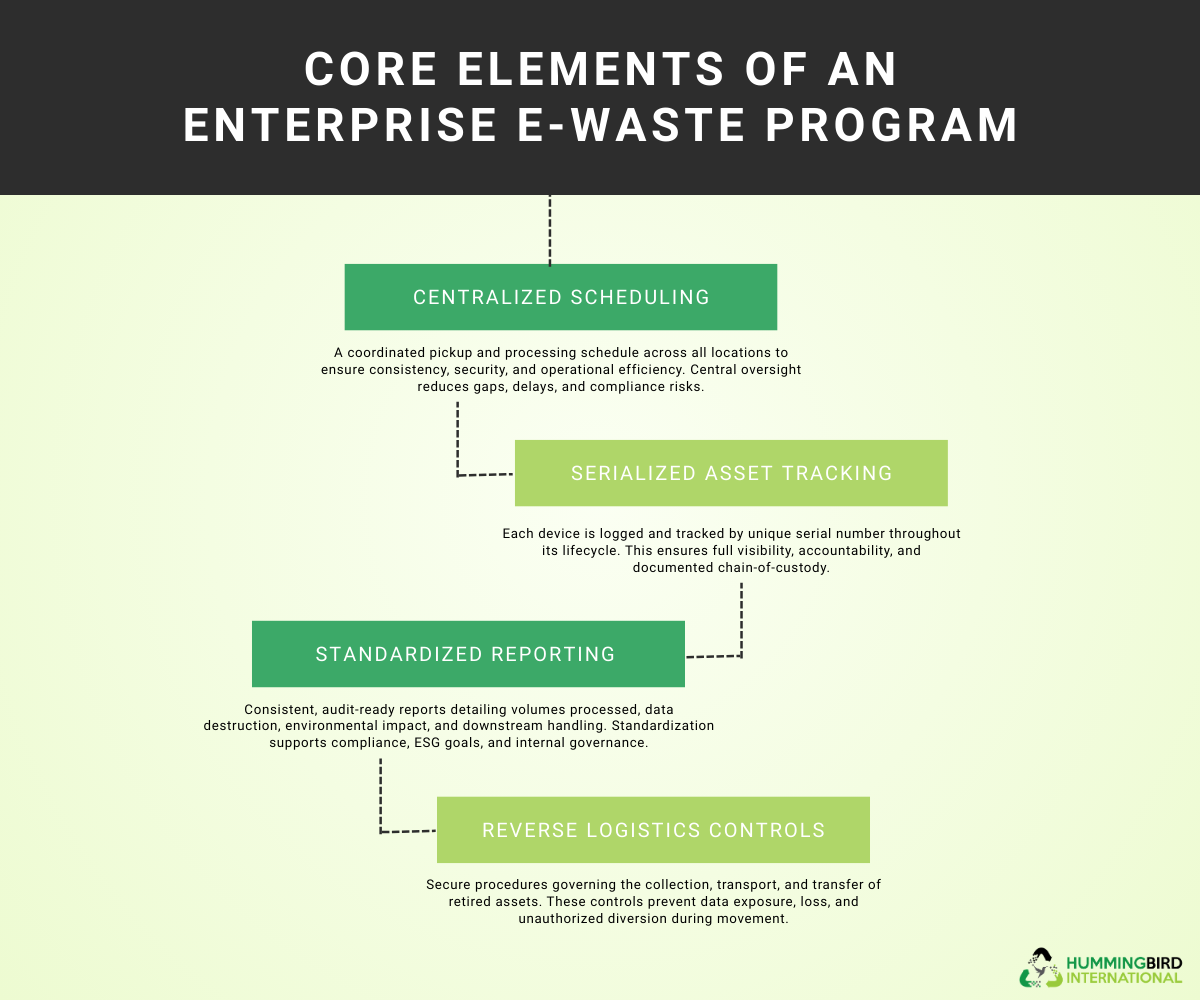
- Centralized scheduling: All pickup requests and timelines are managed through a single coordination point, removing local variability and reducing missed or unmanaged disposals.
- Serialized asset tracking: Devices are logged by serial number or asset ID, providing visibility from decommissioning through final disposition and supporting audit validation.
- Standardized reporting: Reports follow a consistent structure across all locations, enabling accurate compliance reviews, ESG reporting, and internal audits.
- Reverse logistics controls: Assets are securely transported from multiple locations to approved processing facilities using defined routes and handling procedures.
Supporting Execution Solutions
Once an enterprise e-waste program is defined internally, execution relies on services that scale those controls across locations without weakening governance or visibility.
- Multi-location pickup
Multi-location pickup services enable coordinated asset collection from multiple offices, facilities, and remote sites. These services follow the enterprise’s established custody, tracking, and reporting requirements rather than introducing location-specific processes.
- Standard e-waste pickup
For individual offices or sites with predictable volumes, standard e-waste pickup services provide scheduled, compliant removal of retired electronics. This approach supports day-to-day asset retirement while remaining aligned with enterprise policies.
- Workflow automation and system integration
ServiceNow integrations embed e-waste requests, approvals, and status tracking directly into existing enterprise workflows. Automation reduces manual handling, improves data accuracy, and ensures consistent execution across all locations.
Related Article:
E-Waste Pickup for Multi-Location Businesses
Specialized Business Scenarios
Not all e-waste fits neatly into standard pickup or routine asset retirement workflows. Certain business situations introduce higher volumes, tighter timelines, elevated data risk, or regulatory pressure that require more deliberate planning and specialized handling. These scenarios are where informal or generic disposal approaches tend to fail.
The following are the most common enterprise scenarios that demand added controls and customized execution.
-
Data Center Decommissioning

Image Source: iStock/Oselote
When enterprises retire servers, storage arrays, and networking equipment, the process extends far beyond removal. Data center decommissioning requires controlled teardown, verified data destruction, and coordinated material recovery to avoid service disruption or data leakage.
Assets must be inventoried, sanitized, or destroyed according to policy, and removed in phases that align with operational and compliance requirements. Proper decommissioning reduces security exposure while allowing organizations to recover value from reusable infrastructure.
-
Office Closures, Relocations, and Mergers

Image Source: iStock/Liudmila Chernetska
Large-scale transitions such as office closures, relocations, or mergers often trigger sudden spikes in retired equipment. These events compress timelines and increase the likelihood of mixed asset conditions, undocumented devices, and inconsistent handling across locations.
In these scenarios, e-waste must be managed as a coordinated project rather than routine disposal. Centralized oversight, secure transport, and consistent documentation are essential to prevent asset loss, data leakage, and compliance gaps during periods of operational change.
-
Commercial vs Residential Disposal

Image Source: iStock/Charnchai
A common risk scenario occurs when business assets are mistakenly routed through residential or consumer recycling pathways. Understanding the distinction between residential and commercial disposal prevents missteps that expose organizations to unnecessary risk.
| Feature | Commercial Disposal | Residential Disposal |
| Data Security | Certified data wiping and destruction | Not guaranteed; often no data handling |
| Compliance and Reporting | Audit-ready documentation for regulatory requirements | Minimal or no documentation |
| Volume Handling | Designed for large-scale enterprise assets | Small, household volumes only |
| Chain of Custody | Maintained from collection to final processing | Not tracked; assets may be commingled |
| Regulatory Alignment | Meets environmental and data protection laws | Focuses on basic environmental recycling only |
| Reuse/Recovery Options | Supports refurbishment and resale | Rarely considered |
Computer and Monitor Preparation
Proper preparation of computers and monitors before recycling plays a direct role in security and recovery outcomes. Devices that are prepared correctly reduce the risk of data exposure, streamline processing, and improve reuse or material recovery. Preparation also helps assets move through recycling workflows without delays or compliance issues.
Guidance on preparing monitors or LCDs for recycling ensures displays are handled safely and in line with environmental requirements. For computers, weighing the pros and cons of recycling helps businesses decide whether reuse, resale, or destruction is the most appropriate path.
Pros of recycling computers
- Reduces the risk of data exposure when proper data destruction is applied
- Supports environmental compliance and sustainability objectives
- Enables recovery of reusable components and valuable materials
- Frees up storage space and reduces asset management overhead
- Improves audit readiness through documented disposition
Cons of recycling computers
- Improper preparation can leave residual data on storage devices
- Older or damaged equipment may have limited recovery value
- Inconsistent processes across locations increase compliance risk
- Additional handling may be required for mixed or non-standard assets
- Poor documentation can weaken audit and reporting outcomes
These considerations reinforce why business e-waste requires situational decision-making rather than a single disposal approach.
ESG, Sustainability, and Circular Economy Impact
E-waste recycling plays a measurable role in environmental, social, and governance (ESG) strategy, supports long-term sustainability goals, and advances circular economy initiatives. When managed correctly, e-waste programs generate both compliance value and real, reportable impact.
-
ESG Reporting
Environmental, Social, and Governance (ESG) frameworks are increasingly central to how investors, regulators, and customers assess company performance. Responsible e-waste recycling feeds directly into environmental and governance pillars, providing quantifiable data for sustainability disclosures.
A 2022 survey found that 88 percent of investors now consider ESG performance when making investment decisions, with environmental metrics such as waste management becoming increasingly important.
For ESG reporting, e-waste recycling offers clear metrics businesses can report year over year, including:
- Volume of electronics diverted from landfill
- Percentage of assets recycled versus disposed of
- Data destruction and compliance verification
- Responsible reuse or resale outcomes
Well-documented e-waste programs demonstrate governance discipline and commitment to environmental stewardship, strengthening annual ESG disclosures, sustainability reporting frameworks, and external audits.
-
Sustainability Goals
Corporate sustainability goals frequently include targets for waste reduction, responsible procurement, and resource efficiency. E-waste recycling supports all of these by keeping hazardous materials out of landfills and recovering valuable components for reuse or material reclamation.
To maximize the impact of sustainability initiatives, organizations should also focus on employee awareness and engagement. Clear communication materials, such as recycling guides, posters, and internal campaign visuals, can help employees understand proper e-waste disposal practices. An AI poster designer can help businesses create professional educational materials that promote recycling programs and encourage participation across the organization.
The global production of e-waste reached over 60 million metric tonnes in 2023, and only about one-quarter of that was documented as formally recycled.
This gap between generations and responsible recycling highlights a major opportunity for businesses to improve sustainability performance. By integrating e-waste recycling into broader environmental initiatives, organizations can:
- Reduce their contribution to toxic waste streams
- Lower the environmental footprint of procurement cycles
- Extend the usable life of materials through refurbishment
- Align operational practices with corporate sustainability commitments
Sustainability leaders view e-waste recycling as a lever for tangible progress — not just compliance.
-
Circular Economy Initiatives
A circular economy aims to keep products, components, and materials in use for as long as possible, extracting maximum value before responsibly reintegrating materials into new production cycles. E-waste recycling is a core pillar of this model because electronics often contain precious metals, rare elements, and high-value components.
According to a 2023 report, the value of raw materials in global e-waste was estimated at US$ 91 billion, yet only a fraction of that value was recovered through proper recycling and reuse. In practical terms, circular economy value from e-waste includes:
- Refurbishing functional equipment for extended use
- Salvaging components for secondary markets
- Reclaiming metals and materials for manufacturing
- Reducing demand for virgin resources
For businesses, embedding e-waste recycling into circular economy strategies helps close material loops and supports innovation in product design, procurement, and lifecycle management. It elevates the conversation from waste disposal to value retention and resource efficiency.
Also Read:
How to Choose the Right E-Waste Recycling Partner
Selecting the right e-waste recycling partner matters as much as having a strong internal program. A qualified provider becomes an extension of your controls, not just a vendor that removes old equipment.
The wrong choice exposes you to data risk, regulatory gaps, and compliance failures. The right partner delivers secure outcomes, documented processes, and consistent performance across every location.
When evaluating potential partners, look for the following capabilities:
-
Certified ITAD and Recycling
Your partner should offer formal IT Asset Disposition (ITAD) services that meet recognized industry standards. Certified ITAD ensures assets are handled with secure processes, appropriate data controls, and environmentally responsible recycling practices.
-
Documented Data Destruction
Data destruction must be verifiable and traceable. A qualified partner will provide certificates of destruction for every device and media type, showing that data wiping or physical destruction was performed according to accepted standards.
-
Transparent Reporting
Reliable reporting is non-negotiable for compliance, audits, and ESG disclosures. Look for partners that offer clear, accessible reports detailing volumes processed, methods used, and asset outcomes — from reuse and resale to recycling or destruction.
-
Nationwide Logistics
If your organization operates in multiple regions or locations, your partner should support coordinated logistics. Nationwide pickup, reverse logistics, and standardized handling across sites prevent gaps in the chain of custody and reduce operational complexity.
-
Compliance Guarantees
A strong partner stands behind regulatory compliance. This includes adherence to environmental laws, data protection regulations, and industry best practices. Compliance guarantees and contractual commitments protect your organization if a provider fails to meet agreed standards.
Choosing a partner with these core strengths gives you confidence that retired electronics are processed securely, compliantly, and with transparency — turning what is often a risk to your business into a controlled, accountable part of your operations.
Start Secure, Compliant E-Waste Recycling Today
Proper e-waste management turns retired electronics from a potential liability into a secure, trackable process. Whether handling individual devices, full office transitions, or large-scale data center decommissioning, following structured recycling and ITAD protocols ensures data security, regulatory compliance, and environmental responsibility. With the right partner, every asset is accounted for, documented, and processed efficiently, letting your business focus on operations while meeting sustainability and audit goals.
Frequently Asked Questions
Check out the recycling FAQs, which address common questions businesses have about costs, compliance, and asset handling. They are designed to clarify how enterprise e-waste recycling works in real-world operational and regulatory contexts.
1. How much does business e-waste recycling cost?
Costs vary based on asset volume, device type, data destruction requirements, and pickup logistics. For example, a pallet of laptops with certified data wiping will be priced differently from bulk monitors or physically destroyed drives. For a realistic breakdown of pricing factors, see Actual Cost of Recycling in the USA.
2. What happens to devices with no resale value?
Devices that cannot be reused or resold are routed through certified material recovery streams. Components and raw materials are separated and processed responsibly, and nothing is sent to landfill. This ensures environmental compliance while supporting sustainability and circular economy goals.
3. How long should companies keep e-waste audit records?
Most regulations require businesses to retain e-waste, ITAD, and data destruction records for three to seven years, depending on industry, data sensitivity, and regional laws. Keeping records beyond the minimum is often recommended to support audits, legal inquiries, and ESG reporting.
4. Is e-waste recycling mandatory for businesses?
Requirements vary by country, state, and industry. Many regions mandate proper disposal of electronics containing hazardous materials, and regulated data industries may require certified destruction. Even where not strictly required, responsible recycling reduces risk and supports ESG and sustainability goals.
5. Can businesses recycle e-waste from remote or home-office employees?
Yes. Specialized programs exist for collecting devices from distributed workforces. Partners provide secure pickups, verified data destruction, and centralized reporting to ensure compliance, even when devices are outside traditional office locations.


Leave a Reply