Our world is drowning, but not in water, in discarded electronics. Chargers, laptops, TVs, smartwatches, and the list goes on. The volume of e-waste is surging, and the pace is alarming. And that’s not all. Many of these devices are packed with hazardous materials like lead and mercury, and discarding them carelessly is a big threat to the environment.
But at the same time, the U.S. still has no sweeping federal law governing e-waste recycling or disposal. This automatically puts the burden on individual states. This includes rules; their effectiveness can all depend on where you live.
So in 2025, the question is not just which states have an e-waste law but also how effective that law is.
Models Of State Legislation
Many states layer landfill bans or disposal restrictions, making their systems hybrid rather than a single, strict model. However, e-waste law is limited to two main models, and U.S. states generally follow one of them:
-
Extended Producer Responsibility
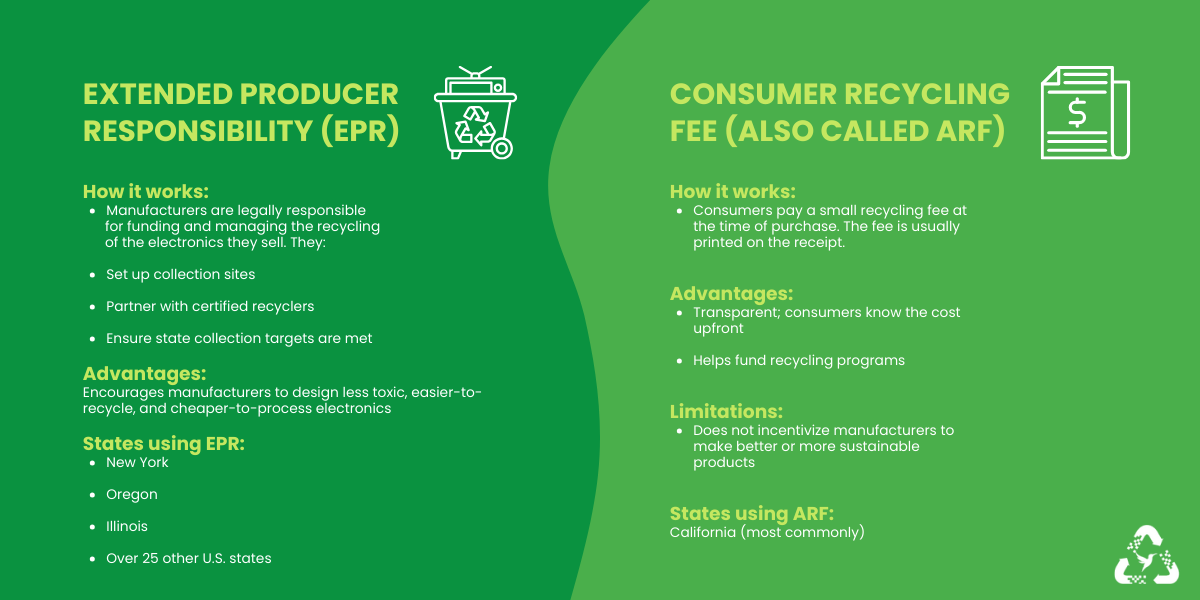
The Extended Producer model is the first choice in more than 25 U.S. States, including New York, Oregon, and Illinois. In this model, manufacturers are legally responsible for funding and managing the recycling of the electronics they sell.
The producers set up collection sites, set up contracts with certified recyclers, and ensure that the state’s collection targets are met. This is the biggest advantage of EPR: it actually pushes manufacturers to design better products. This way, they create electronics that are less toxic, easier to recycle, and cheaper to process.
-
Consumer Recycling Fee
Even though this approach is less common, the ARF approach is most commonly used in California. This model shifts responsibility to the consumer, who pays a small recycling fee at checkout when they buy a new device.
This model is far more transparent than the EPR model, as it clearly states the recycling fee on the receipt. But this does not incentivize manufacturers to produce better products since they are not responsible for recycling.
| State / Jurisdiction | E-Waste Law? | Type of Law / Model |
| Alabama | No | Not Applicable |
| Alaska | No | Not Applicable |
| Arizona | No | Not Applicable |
| Arkansas | No | Not Applicable |
| California | Yes | Consumer Fee / Advanced Recycling Fee |
| Colorado | No | Not Applicable |
| Connecticut | Yes | Producer Responsibility / Take-back law |
| Delaware | No | Not Applicable |
| District of Columbia | Yes | Producer Responsibility / Take-back law |
| Florida | No | Not Applicable |
| Georgia | No | Not Applicable |
| Hawaii | Yes | Producer Responsibility / Take-back law |
| Idaho | No | Not Applicable |
| Illinois | Yes | Producer Responsibility / Take-back law |
| Indiana | Yes | Producer Responsibility / Take-back law |
| Iowa | No | Not Applicable |
| Kansas | No | Not Applicable |
| Kentucky | No | Not Applicable |
| Louisiana | No | Not Applicable |
| Maine | Yes | Producer Responsibility / Take-back law |
| Maryland | Yes | Producer Responsibility / Take-back law |
| Massachusetts | No | Not Applicable |
| Michigan | Yes | Producer Responsibility / Take-back law |
| Minnesota | Yes | Producer Responsibility / Take-back law |
| Mississippi | No | Not Applicable |
| Missouri | Yes | Producer Responsibility / Take-back law |
| Montana | No | Not Applicable |
| Nebraska | No | Not Applicable |
| Nevada | No | Not Applicable |
| New Hampshire | No | Not Applicable |
| New Jersey | Yes | Producer Responsibility / Take-back law |
| New Mexico | No | Not Applicable |
| New York | Yes | Producer Responsibility / Take-back law |
| North Carolina | Yes | Producer Responsibility / Take-back law |
| North Dakota | No | Not Applicable |
| Ohio | No | Not Applicable |
| Oklahoma | Yes | Producer Responsibility / Take-back law |
| Oregon | Yes | Producer Responsibility / Take-back law |
| Pennsylvania | Yes | Producer Responsibility / Take-back law |
| Rhode Island | Yes | Producer Responsibility / Take-back law |
| South Carolina | Yes | Producer Responsibility / Take-back law |
| South Dakota | No | Not Applicable |
| Tennessee | No | Not Applicable |
| Texas | Yes | Producer Responsibility / Take-back law |
| Utah | Yes | Voluntary / Less-strict model |
| Vermont | Yes | Producer Responsibility / Take-back law |
| Virginia | Yes | Producer Responsibility / Take-back law |
| Washington | Yes | Producer Responsibility / Take-back law |
| West Virginia | Yes | Producer Responsibility / Take-back law |
| Wisconsin | Yes | Producer Responsibility / Take-back law |
| Wyoming | No | Not Applicable |
Key Milestones in U.S. E-Waste Law
The evolution of e-waste legislation in the U.S. didn’t just happen overnight. Here is a clear year-by-year look at how different states built the e-waste law framework.
2003: California became the first U.S. state to pass a comprehensive e-waste law.
2004: Maine passed the second state law, making manufacturers responsible for the collection and disposal costs of old TVs and computers.
2005-2006: Maryland (2005) and Washington State (2006) enacted laws focused on manufacturer responsibility, with Washington encouraging the reduction of toxic materials in electronics.
2007: Five states—Connecticut, Minnesota, Oregon, Texas, and North Carolina—passed e-waste legislation, including a successful computer takeback program in Texas.
2008: A record nine states adopted e-waste laws: Rhode Island, Hawaii, Illinois, Michigan, Oklahoma, Virginia, Missouri, New Jersey, and West Virginia.
2009: Wisconsin and Indiana joined, both setting specific volume- or weight-based recycling targets for manufacturers.
2010: Four additional states enacted recycling laws: Vermont, New York, Pennsylvania, and South Carolina.
2011: Utah adopted a unique law requiring companies to educate consumers about e-waste threats instead of mandating collection.
2012: Colorado banned certain electronics from local landfills when the law was signed on Earth Day.
2014: The District of Columbia (D.C.) instituted its own e-waste law.
2016: D.C. updated its rules to establish new specifics for electronics stewardship.
2017: Illinois updated its Consumer Electronics Recycling Act to expand collection obligations.
2018: California and D.C. implemented updated regulations to refine their existing e-waste recycling programs and enforce landfill bans.
2020: California updated its fee structure and payment rates for recyclers participating in the Covered Electronic Waste (CEW) program.
2022: California passed the Responsible Battery Recycling Act, requiring battery makers to establish a statewide stewardship program to collect and recycle covered batteries.
2023: New York amended its law to require manufacturers to provide free collection of used electronics, eliminating consumer recycling fees for certain items.
2023: Federal efforts emerged, including the introduction of H.R. 4217 (SECURE Act), aiming to control the export of U.S. e-waste.
2024: Maine passed a law making manufacturers financially responsible for the recycling of rechargeable batteries.
2025: Texas enacted a Right to Repair law, requiring manufacturers to provide parts and tools for electronic device repairs.
How These Laws Affect You In 2025
The impact of states strengthening e-waste rules is showing up in everyday life. The devices you choose, how you dispose of them, and what you pay at checkout are all shaped by your state’s approach to e-waste. And these changes are not just limited to everyday consumers; businesses and manufacturers are also facing their impact.
Everyday Consumers
When recycling, it is always best to learn about your state’s e-waste policy. Some states offer free drop-off programs funded by manufacturers. Hummingbird International provides local options for responsibly disposing of your electronics.
Businesses
Companies that generate a large volume of electronics might find it more difficult. Many states require businesses to submit proper documentation for asset disposal. This is why you must connect with certified recyclers to have the proper documents.
Manufacturers
States that opt for the EPR law push brands to make better products that last longer and are easier to recycle. This shift is influencing brands to be more proactive.
In a nutshell
Even if your state hasn’t fully rolled out an e-waste policy, you can still recycle responsibly. But it is your recycling choice that makes a difference. Local governments and organizations are understanding the value of proper asset disposal, and by supporting accessible programs, you can ensure your assets are reused, repurposed, and kept out of landfills.
FAQs
Can I still recycle electronics in a state without a law?
Yes, if your state does not have an e-waste law, you can still use certified recyclers, manufacturers’ take-back programs, or local drop-off sites.
What types of electronics are covered under most state laws?
Most state e-waste laws cover computers, laptops, monitors, TVs, and sometimes peripherals like printers, keyboards, and scanners. Some newer laws are expanding to include tablets, e-readers, rechargeable batteries, and other small electronics.


Leave a Reply